Showing posts with label history of Sabah. Show all posts

Wednesday, June 27, 2012

The German Connections


Many of us in Sabah are familiar with the ruins of what was once the magnificent Kinarut Mansion. Built during the years preceding WWI by a German named W. F. C. Asimont and partially demolished by the North Borneo Chartered Company (NBCC) in 1923, the mansion remains shrouded in mystery. Why did the government allow Asimont to build such an imposing dwelling only to destroy it within ten years of its existence?
Kinarut Mansion ruins (Photo credit: Richard Sokial)

Asimont was an expert on rubber and was hired as the first manager of the Kinarut Estate, a rubber plantation owned by a British company called Manchester North Borneo Ltd. It was the second largest rubber estate after Sapong Estate. Asimont was interned during WWI and, apparently, that was the last thing people knew about him. There had been other Germans in NB and they came long before Asimont. Somehow, like Asimont, their stint in NB had been short and—shall we say, disastrous?

Twenty-six years before Mr. Asimont’s sojourn at Kinarut Estate, two Germans—Herman Friedrich Meyerink and Friedrich Hockmeyer—founded the German Borneo Company (GBC) in Germany. The GBC was taking advantage of offers by the NBCC which was eager to attract investors to open up agricultural lands in NB. The German company was offered 10,000 acres for $4,500 at Banguey (Banggi!).
Map of northern Sabah (North Borneo)

H.F. Meyerink and his assistant, Carl Eduard Funcke, arrived in Banguey in 1884 where they established Hacienda Nicolina. Chinese coolies were employed to work on the plantation. However, by mid-year a group of coolies revolted, stole a boat and attempted to escape. Meyerink and his assistant pursued the fleeing coolies and when they were threatened with parangs, the Germans fired several shots. Two men later succumbed to their injuries. The NBCC was blamed for the deaths through its failure to take the wounded to the Kudat Hospital.

Naturally, the NBCC wasn’t too pleased! The company started an investigation which revealed that the coolies were forced to endure bad working and living conditions, ill-treatment by the German managers and Meyerink’s ill-temper. Now it was the Germans’ turn to get upset because they faced ten years in prison! They had come to Borneo to make money for the GBC, not to rot in some prison!

They solved their problem by leaving Hacienda Nicolina in the hands of one John Carnarvon before fleeing to Jolo in August 1884. They established a new plantation on Jolo, Gomantong Plantation, on behalf of the GBC. We have to give them credit for their diligence, for not wasting any time moaning about their misfortune and for being responsible to the shareholders of GBC.

However, fortune wasn’t on their side. It was more like out-of-the-frying-pan-into-the-fire kind of situation. The Gomantong Plantation in Jolo was doomed from the start. A civil war raged—the result of conflicts of succession caused by the death of the sultan. There were numerous attacks on the plantation: the coolies died or were injured; the Germans were threatened; cultivation and harvesting were hampered.

When the Spaniards failed to curb the attacks, Meyerink sent an SOS to Germany which sent a warship to Sulu!  It was to protect German property but Spain suspected Germany of ulterior (political) motives. Spanish Governor, Arolas, sent support (27 soldiers) to Hacienda Gomantong but situation didn’t improve and the plantation was abandoned in 1889.

Meanwhile, back at Hacienda Nicolina in Banguey with John Carnarvon, the situation wasn’t much better. Hamburg sent a new manager, Joseph Lind, and pumped more capital into the venture which in 1888 included a plantation on the mainland, in Bengkoka, but nothing worked in the Germans’ favour. The coolies felt exploited; Lind, the manager, felt the NBCC were not supportive and the NBCC blamed the Germans for starting all the trouble. More misfortune struck when a harvest (probably tobacco) sank with the steamer off the coast of Somalia.
What the Kinarut Mansion looked like before it was demolished (Drawn by Richard Sokial)

In January 1889, exactly five years after the GBC was founded, the board of directors decided to dissolve the company, thus ending the presence of a German company in NB.

Can you imagine what could have happened if the GBC’s ventures had been successful in Banggi and Bengkoka? (During that time Germany had colonized part of New Guinea and several islands in the Pacific.) Who knows, German presence could have become permanent in NB and the grand Kinarut Mansion could still be standing and looking out into the South China Sea!
A beautiful book to treasure!

Reference: The Sarawak Museum Journal; Colonial Townships in Sabah

Thursday, June 21, 2012

A Letter to My Anak Buah


Dear Koyoh and Gurongit, it pays to know your history so you don’t burst a vein every time some folks say Sabah belongs to them. Many people repeat stuff they’ve heard, about something they know nothing about. With that in mind, I suggest you check the facts and don’t take everything I’m saying here as the truth although I’ll tell you as closely as possible what I’ve learnt about Sabah of the 1800s.

This was a period, long past long ago, when pirates prowled along the coasts and headhunters roamed the countryside. It was long before the word ‘Sabah’ magically evoked images of black gold and dollar signs, and ages before the natives discarded their loin-cloths for made-in-Thailand underwear.
An old map of Brunei

Sabah (North Borneo) was still under Brunei then. Do you know that Brunei used to be a huge part of Borneo? The Brunei Sultanate stretched all the way from present day Sarawak to the tip of Borneo. Apparently, from the very beginning we, the natives, have been the source of income for various sultans and pengirans of Brunei. These overlords or their proxies collected poll-taxes from the people residing in their jajahan and tulin— which were really river valleys. That was why they were also known simply as sungei.

Then the white men came…

The Americans were never really interested in Sabah. However, they did offer protection to Brunei —from pirates and invaders?—in return for friendship and commerce. Brunei declined the offer because the Sultan was optimistic of obtaining British protection. Various diplomatic missions were dispatched by the Americans to the Far East including Borneo in the early 1800s.This was mainly for commercial interests, not colonial expansion.

1845: The USA offered Brunei protection in exchange for friendship and commerce. Brunei, optimistic of obtaining British protection, declined the offer.

1850: The USA obtained commercial privileges and right to establish a consulate in Brunei.

1865: The USA established a consulate in Brunei with Claude Lee Moses as Consul.

Moses was more interested in making money for himself. He saw that the Sultan hoped to use US presence in Brunei as a counter-weight against Sarawak expansion. (The Sultan had given Sarawak to James Brooke in 1846 for the latter’s role in curbing piracy… and now James Brooke wanted Sabah too!)
Borneo (Google Image)

With the dwindling empire/sultanate, the Sultan and his pengirans were getting less rich  due to loss of income because there were fewer subjects from whom to collect poll-taxes. Moses shrewdly persuaded the Sultan to lease him large concessions in Sabah for yearly rents.

Sultan Abdul Mumin leased the land from the Sulaman River to the Paitan River for $4500 annual rent. The Pengiran Temenggong signed another agreement to lease Benoni, Kimanis, Paitan, Sugut, Bongaya, Labuk, Sandakan, Kinabatangan, Cagayan and Muming for $4000 annual rent for ten years but could be renewed.

(Note: Brunei also leased areas which were not under its jurisdiction but were supposed to be under Sulu rule. Why? More about this later…)

Moses was now ‘lord and master’ of huge tracts of land in Sabah leased from the Sultan. Was he going to develop the land? No. This was before the rubber era of the next century. Was he going to collect taxes on the inhabitants of his concessions?  No! Moses quickly left for HK and was able to sell his concessions to two Americans—Joseph William Torrey and Thomas Bradley Harris, and a Chinese named Wo Hang.
Harris and Torrey (Google Image)

Torrey formed the America Trading Company of Borneo (ATC) to develop the land he had acquired.

Sultan Abdul Mumin signed a document on 24 November 1865 appointing Torrey as Rajah of Ambong and Maroodoo with the powers of life and death over the inhabitants; the right of making laws, coining money, creating an army—together with the powers and rights usually exercised by and belonging to sovereign rulers. So, Torrey was made a white rajah just like James Brooke in Sarawak!

With 12 Americans and 60 Chinese, the ATC opened a settlement in Kimanis. The new settlement was given a pretty name: Ellena. The plan was to develop commercial agriculture planting sugar cane, tobacco and rice. Unfortunately, the company had to be abandoned at the end of 1866 due to a number of reasons. Thomas Harris died after suffering a high fever. There was shortage of capital; there was sickness among the settlers and there was  labour unrest.
Thomas B. Harris's tombstone at Kimanis

Torrey returned to HK to look for someone who'd be interested to buy his property. Among those who expressed interest in this far-flung wilderness was Italy. Apparently, Sabah was perfect for a penal outpost where convicts could be sent to exile! Didn’t happen, by the way. (Can you imagine Romeos and Juliets labouring in the paddy fields and living in little water villages?)

1875: Finally, after almost ten years of looking for a buyer, an Austrian named Gustavus Baron Von Overbeck, offered Torrey $15,000 for the concessions if the Sultan of Brunei would renew the leases. The Sultan refused! So, Overbeck, having been turned down by Vienna, turned to Dent Brothers (London) for financial support.
Alfred Dent (Google Image)

1877: Alfred Dent saw great potential in the Sabah venture so in March 1877 they formed the Overbeck-Dent Association (ODA) to obtain the Sabah leases with the intention of selling them for a profit.

Dec 29, 1877: Sultan of Brunei leased his Sabah estates to Overbeck and Dent for an annual payment of $16,000—except for some tulin/private lands from Kimanis Bay in the west to the Kinabatangan River in the east. ODA appointed William Pryer as the first Resident of NB. He was to be based in Sandakan, was to eradicate piracy and establish an administrative centre for NB.
Photo credit: J. Kessey

A few weeks after the Sultan of Brunei had leased his lands to ODA, the Sultan of Sulu also sold his share of NB to Overbeck.

1883: Pangalat, Putatan, Kawang and Mantanani Islands were leased by Brunei to the British.

1884: The Sultan of Brunei signed over the Padas and Klias Rivers, and Tuaran, Bongawan for additional sums.

Jan 22, 1878: The Sultan of Sulu on the island of Maibu ( having been ousted from Jolo by the Spanish) relinquished his claim on all his territories in return for $5000 [five thousand dollars] a year, the same land the British was already paying $12,000 per year to Brunei.

1898: By 1898 the British NBCC owned the rights to every square centimeter of land in Sabah.

Now, Koyoh and Gurongit, which part of Sabah did some clown claim belong to them?

Love,
Aunty Tina


(p.s. Homework! Find out when the leases were transferred from ODA to the NBCC.)


Reference: British North Borneo Herald

Friday, June 08, 2012

Off to the Races!


What is all this excitement at the racecourse that can make grown men act like kids with a brand new toy? Well, just the other day I went to see for myself. It was the first time I went to the race tracks since the Royal Sabah Turf Club (RSTC) moved to Tambalang in Tuaran—although I’ve been to the stables many times. I didn’t know what to expect, except ponies and horses and their jockeys, of course.

But first a little history about pony racing in Sabah…  

Initiated by the European community, the first pony races in Sabah were held in Sandakan in 1892. The pony race craze and excitement spread to the other towns and tracks were made in Jesselton, Kudat, Kota Belud and Labuan. Incidentally, when the North Borneo Chartered Company (NBCC) was looking for an alternative site to rebuild the town after the 1897 fire at Pulau Gaya, the Company noted that the wide open ground at Tanjung Aru would be perfect for a racecourse.

The first tracks were straight and only four furlongs (half a mile) in length. These tracks were later formed into rings which exceeded eight furlongs. The earliest ‘grandstands’ were viewing shacks of wood and attap. Even posts were good as viewing stands! Now there’s a modern grandstand at the Tambalang race course in Tuaran and it can accommodate thousands of spectators.


Whereas today the riders/jockeys are local men, during the NBCC era, only Europeans were permitted to ride in Jesselton and Sandakan. In the smaller towns, because there were not many European riders, the natives were allowed to compete with the white men. 

The ponies were of Mongolian breed and were brought in from Southern Philippines. Apparently, the Bajau people of Kota Belud have been rearing ponies for generations, hence earning the name ‘Cowboys of the East’. During the NBCC days the ponies were actually used as draught animals for higher ranking officers who qualified for ‘pony allowances’.

These days besides ponies, there are also horses and cross-breeds reared as ‘racehorses’. I’ve been told that race ponies can’t be ‘retired’ as ‘walking’ ponies because they’ve been trained to only run and not to slow canter. Well, at least that was what Mr. Hubby-knows-it-all told me when I suggested we adopt some of the old, unwanted ponies and rent them to leisure riders.

What I saw and learned at the races…

I thought only men go to the races but many women and children go too.

The ponies and horses are walked twice around this oval pitch in front of the grandstand… like beauty contestants, I thought.


The tracks are smoothened… and then sprayed with water before each race.

There were special ‘Cup’ races the day I went because Sabah was celebrating Tadau Kaamatan. Winning ponies receive their prizes immediately after each race.

Many people place bets on their favourite ponies. Forecasts appear in the local papers to ‘help’ them predict and pick the winners.

A jockey has to watch his diet and I’m told he normally weighs around 55kg only! The RSTC pays the jockey a riding fee for each of the race he runs. The RSTC also keeps track of the jockeys’ performances and awards are given to the ‘Champion Jockey’ every year.

Mr. Hubby’s pony didn’t win that day. Sakit kaki konon.

(Angel Bear, if you're reading this... we'll go to the stables one of these days when you're not busy.)

Wednesday, September 14, 2011

Early Chinese Settlers in British North Borneo

My father hinted that our ancestors had hailed from China but other than saying the family name was ‘Lee’ he volunteered hardly any details. And I, being the timid child I was, pretended I wasn’t interested in dead moyangs who had braved the elements and sailed across the South China Sea. As an adult I was scared to pry for fear of disturbing a skeleton or two in the old family cupboard.

But when you’re surrounded by Chinese, being spoken to in Hakka or Mandarin because “Oh? Kau putih betul orh? Saya pikir kau Cina!”, and married into a Chinaman family, it’s good to know a little about their origin—why, when and how they came to North Borneo. So I did a little snooping around and discovered the following:

An early Chinese settlement in Luyang?
The Chinese have been coming to our shores since time immemorial. According to one historian, Brunei had already established relations with the Middle Kingdom in 518 AD. The Chinese had come to trade, naturally, and by the ninth century, trade between Brunei and China had increased.

In 1521 when Pigafetta (1491 – 1534) visited Brunei, there were already thousands of Chinese cultivating pepper gardens in Brunei. When you consider that NB was Brunei’s jajahan, it’s easy to see how the Chinese population would have spilled over into Sabah.

[Pigafetta sailed around the world with Magellan and was one of the eighteen who lived to tell about their incredible voyage.]

During the NBCC era, the British thought the Chinese would be an asset to the Company because they were ‘hardworking, money-loving Chinese’ who came and worked as traders, shopkeepers and artisans, and coolies in rubber and tobacco plantations. (The NBCC had actually preferred the Chinese labourers, over the other races, to work in the tobacco plantations.) There were, however, very few engaged in agriculture—vegetable gardening or rice cultivation. Farmers were needed to grow food to feed the growing population.  

From 'Journal of Southeast Asian Studies' by Amity Doolittle
 
The natives, the British discovered, were not keen to produce more food than they needed. They were, essentially, subsistence farmers who were hunter-gatherers or engaged in shifting cultivation. So boatloads of Chinese were brought by the British to open up farms in North Borneo.

Source: Bonding with Gaya Street 2012

The responsibility of selecting suitable recruits and arranging their free passages was given to the Basel Mission which, in turn, employed agents in China to look for suitable Hakka families. Why Hakkas? Because the NBCC thought that the Hakkas were natural farmers, the kind who could ‘tickle the soil with a hoe and make it smile with a harvest.’

It was actually a win-win situation because the NBCC wanted ‘tillers of the soil’ and the Hakkas wanted to escape persecution which was caused by the fall of the Taiping Heavenly Kingdom. Then, there was also the shortage of food, the result of natural disasters. Through the Basel Mission, the Chinese were helped to migrate elsewhere, including Hawaii, Malaya and NB.

Whereas in Malaya the recruits were needed to work in tin mines or to cut down forests on lands which would become tin mines, those chosen for NB were to work as farmers on plots given to them free! Land didn’t cost too much then because, as pointed out by one urang putih: “Who would want NB? Leave it to the monkeys!” When Jose Rizal, the Filipino patriot, wanted to settle down in NB he was told he could buy land at $3.00 (yes, three dollars!) an acre. That was in 1892.

Anyway, back to my Chinese story…

In 1913 the first batch of twenty two (NBCC-sponsored) families landed in Kudat and were taken by boat to Jesselton and then up the Darau River to their final destinations. These pioneers were given temporary lodgings on arrival before each family was allocated ten acres of land along the north-south coastal strip making up Telipok, Menggatal and Inanam. More families arrived and three years later they totalled 89 households comprising of 346 individuals.

Each family was given everything they needed to start a farm. The government built a house on their respective plot and they were given “two pigs, four hens, one cock, five ducks, four earthen baskets, two changkols, two parang (bengkok), one big axe, one parang, three bamboo hats, one mosquito net, kitchen utensils including Chinese frying pan, one tin bucket, two empty kerosene oil tins, one rice pot, one vegetable chopper and one rice spoon.” Such a long list for each household! (I have a feeling the parang bengkok is a rimbas, no?)

Rice Farming: ‘The Chinese’ by Danny Wong Tze Ken
 
Regular inspections were carried out to make sure the recruits were okay. The NBCC even asked the shopkeepers in Menggatal to extend these new-comers credit for their daily necessities until they could fend for themselves.

Each family cultivated their respective ten-acre plot. They prospered and there were families who could afford to buy more land and thus enlarged their properties. Some supplemented their incomes by working elsewhere…sawing planks, joining the road gang, blacksmithing. Two families in Telipok kept shops. They settled down.

 They applied for land to build churches and schools, which they ran themselves, and a burial ground to bury their dead. Long before the natives had schools built for them, the Chinese kids were already going to school, such was their enthusiasm for education.

Perhaps your Chinese ancestors came on their own like Mr. Hubby’s paternal (Hakka) grandfather who came here with his family—to escape persecution—and they bought and cultivated their own plot of land in Inanam. Maybe your ancestor opened a shop like my friend, Andrew’s, grandfather did in Tuaran. 

Or you could be like me. You know only your Chinese family name and little else. 


Ref: The Hakka Experiment in Sabah  (Commemorative Publication)  Zhang Delai
The Chinese by Danny Wong Tze Ken 


Sunday, July 17, 2011

War and Hate

Some people say they’ll never be able to forgive the Japanese for the atrocities inflicted on our parents and grandparents’ generations during the Japanese Occupation. I’ve read a few books describing the cruelty of the Japanese soldiers. I’ve also heard first-hand stories of untold suffering inflicted by the Japanese but I couldn’t understand why some people could not forgive and let go of the past.

Now I’m beginning to understand.

I have taken the forgive-and-forget stance because I honestly felt that Japan as a nation has suffered enough and, after the war, her people have gone out of their ways to be helpful and generous to the rest of the world.

But now I can see why it is difficult, probably impossible, to forgive and forget. When the Japanese have tortured your loved ones, subjected them to physical cruelties, mental torture, humiliation and degradation in ways you can’t even begin to imagine, I guess to expect the victims and their families to forgive is asking way too much.


The book I’m reading describes the horrors inflicted on both the innocent and ‘guilty’, people who had the misfortune to cross paths with the Japanese during the latter’s occupation of Sabah. It made no difference to the Japanese whether their victims were men or women; the elderly or children; natives or foreigners; soldiers or civilians.

I don’t want to give the hell-on-earth details here. One has to read the book to see what horrendous experiences the victims had to endure until death took away their miseries. And the sad thing is, the kicking, beating, hitting, slapping, head-hammering, the breaking of bones, chopping of fingers, jumping on distended abdomens, shooting, beheading and acts of cannibalism, etc were not even necessary as, in most cases, the victims complied with what was demanded or asked of them.

So why did the Japanese soldiers do what they did? Because they were following orders? Because having conquered a big portion of mainland Asia and the surrounding islands they were 'drunk' with power? Because they were acting like a mob? Because they felt invincible? Or because cruelty is inherent to their culture?


A few years ago I watched a National Geographic documentary showing some former Japanese soldiers being interviewed and asked about the roles they had played in the Sandakan-Ranau Death March. One of them described how he shot a POW who couldn’t continue walking (due to exhaustion, illnesses and malnutrition.) You’d expect him to relate that with a sense of regret and sorrow, not with a hearty laugh and the ear-to-ear smile he gave the interviewer. Yet, another soldier was able to show his ‘compassion’ when he told how he shot a little child to end his misery because he was calling for his mama who had jumped into their well to escape being raped by his fellow soldiers.

Bushido—the warrior’s code—which the Japanese soldier live by, makes it the soldier’s sacred duty to fight for, and if necessary, die for his emperor. According to this code, the soldier never surrenders to the enemy. To surrender—in the eyes of the Japanese—is to be reduced to an insignificant, contemptible being not even worthy of fair and humane treatment. That is why they practise seppuku—honourable death by cutting across the abdomen-- rather than fall into the hands of the enemies.


It is interesting to note that although a signatory, Japan did not adhere to the Geneva Convention 1929 which, among other things, spells out how POWs are to be treated.

Of interest also is the fact that although the Japanese emperor had surrendered on 15 August 1945, the slaughter and degradation continued far beyond that date, so determined were the Japanese soldiers that not a single POW lived to tell the tales of their horrific experiences.

Blood Brothers is not just a book about POW victims and suffering. It is also about a host of unsung local heroes (and heroines) who risked their lives to alleviate the pain and hunger, if not save the life, of a fellow human being.

While my admiration for the POWs and local people (not all) have gone up by several notches, I’m afraid the opposite is true for the Japanese soldiers. And I don’t think I can ever forgive and forget if I had been a victim. Read the book and you’ll understand.


There are only losers in a war. Both the victor and the vanquished have to count their dead, add up their losses and lick their wounds before they could continue with their lives.

Let me end with a quote from Three Came Home which Agnes Keith wrote so others could ‘shudder with me at the horror of war’. She, too, had suffered Japanese brutality.

“The story of war is always the story of hate; it makes no difference with whom one fights. The hate destroys you spiritually as the fighting destroys you bodily.”


Note: The hand (Google Images) holds some of the metal buckles, clips and a single button the POWs buried under a tree in Ranau (shortly before they died) so people would know they had been there.

Friday, July 01, 2011

Before the White Men Came

Another short history lesson… tralala...  What was life like for the Dusun on the east coast of Sabah about  two centuries ago?

While the west coast of Sabah was Brunei’s jajahan (dependencies), the east coast came under the influence of the Sulu Sultanate from late 18th century to the 19th century.

Because of regular and widespread flooding of the big rivers on the east coast—the Segama, Kinabatangan, Sugut, Labuk, Paitan—the Dusun* avoided the flood-prone plains on the lower courses of the rivers, the river mouths and the fertile deltas. Instead they settled in the middle and upper courses, practiced shifting cultivation and planted hill paddy.

*Ranjit Singh used ‘Kadazandusun’ which is a recent tag and FYI, I don’t quite subscribe to it because ‘Kadazan’ denotes the indigenous people of Penampang and Papar while ‘Dusun’ the other regions of Sabah. Example: Dusun Tindal of the Tempasuk region, Dusun Lotud of Tuaran, Dusun Rungus of Kudat, etc.

Dusun girls (Oscar Cook)
Probably an important reason for keeping to the upper courses of the rivers (as pointed out by the author of ‘Blood Brothers’) was to avoid pirates who frequently raided villages situated along the lower courses in search of booty and slaves.

I imagine the Dusun working hard and living simply but contentedly in small communities along the upper courses of the rivers. All their needs were within reach in the virgin jungles around them: animals for food and game, edible jungle greens, building materials, etc. Well, maybe they’d miss salt which of course they couldn’t pluck from the forest but it was easily obtainable from the coastal areas. All they needed to do was row down the river ‘highways’ which were navigable for long distances upstream. The forests were excellent sources of jungle produce such as damar, rattan, camphor, bees’ wax, gutta percha. And these could be brought downstream in exchange for salt, fabric, jars and other ‘luxuries’ from Suluk traders.

Traders from Sulu discovered that by playing middlemen, they made handsome profits when they brought Chinese jars, brass gongs, cloth to the Dusun upriver in exchange for the jungle produce which were much sought-after by the Chinese.

The jungle produce were shipped to Jolo (pronounced Holo!) which was the last port of call for the Chinese junks on their annual route to the eastern flank of Borneo.

Tapping damar (Google Images)
From the late 18th century there was an upsurge of trading activity in Jolo because European ships began to call at Jolo (where the Sultan of Sulu was based) to acquire goods to trade with China. Jolo was becoming an important commercial centre! Now, if you had been the Sultan of Sulu, what would you have done? Why, get more goods for the Chinese, of course! More forest produce meant more trading and, therefore, accumulating more wealth.

Suddenly, the east coast of Sabah became an important source of income—free durian runtuh from the forest and the sea (because Sabah was rich in both forest and marine produce.) The Sulu Sultanate could not touch the west coast because that was Brunei jajahan.

Suddenly, waiting for the Dusun to supply the forest produce was too slow and the consignments too small to meet demands. Unlike the Brunei overlords, the Sulu Sultan did not appoint local proxies to oversee the collection of stuff from Sabah. He appointed Suluk datus/aristocrats as governors. He chose datus who had local family ties and strong personal influence in Sabah.

Google Images
The datus/governors’ job: to open up settlements on the east coast and take care of economic activities—mainly collecting forest produce, pearl fishing, collecting marine produce.

So from the late 18th century, Suluk settlements (sponsored by the Sulu Sultanate) sprouted like mushrooms at strategic locations on the lower courses of the great rivers. The majority of the people in these settlements were Bajau. They were not there to open up the land for agriculture. They were there to harvest natural resources from Sabah’s rich forests and waters and bring the goodies to Jolo! They didn’t have to wait for the Dusun to bring the forest produce downriver. They organized their own expeditions (some taking as long as a month) to collect the jungle produce themselves. Maybe ‘plunder’ is too harsh a word, huh? (Damn, for some reason the word ‘petroleum’ in blood-red capital letters is blinking in my head.)

Anyway, the Bajau population in the new settlements was too small to support the economic activities. More people were needed for labour so the Suluks did what they knew best. (Ref: The Pirate Wind)

They went on large scale slave-raiding expeditions! Hapless people/farmers/fishermen were snatched off the coasts of the Philippines, Borneo and even New Guniea—the natives of NG were a ‘novelty’ with their frizzy hair and whatnot—and all captives were taken to Jolo, the collection centre, and sold as slaves.  Many of them ended up labouring in the Suluk datus/governors’ economic enterprises on the east coast of Sabah.

Men from Sulu (Google Images)
The Sultan gave free rein (complete freedom bah!) to the Suluk datus/governors to do what they pleased as long as they:


Transmitted to the Sultan his share of the royalties.

Gave the Sultan the 10% import tax levied in his name.

Ensured that all marine and jungle produce were shipped to Jolo.

Just like today’s rich who become richer through ingenuity and blahblahblah, those days the Suluk datus/governors accumulated wealth through shrewdness and craft.

One method was to introduce their own taxes by controlling the traffic which went up and down the river. Imagine our modern-day roads where you must get a ticket to enter certain routes and pay a fee at a booth on your way out. Well, those days the rivers were highways and the datus/governors set up custom houses (similar to our modern ‘toll’ booths) along the rivers. A bamboo or rattan slung across the river was lifted after the boat owner had paid a duty. No pay, no entry! Clever, eh?

Old Chinese jar (Google Images)
The datus/governors also imposed ‘sarar’ which was a system of ‘forced trade’ whereby village folks were forced to buy, say a Chinese jar or a gong or cloth, at sky-high/tak berbaloi prices to be paid with a certain amount of jungle produce—even though the villagers had not wanted the merchandise in the first place. (Hmmm, how come I’m thinking of that damn email thing which everyone above eighteen is supposed to get?)

The governors were also free to conduct slave trading and raiding activities. It was perfectly legal for them to pluck any Pacik, Gaman and Sumandak, to sell as slaves or to turn into slaves, and to raid and plunder villages.

On the west coast each household had to pay poll taxes to their Brunei overlords. On the east coast the Dusun communities lived in fear of plundering pirates and bullying traders. Was it a wonder that parents insisted their prospective sons-in-law had human heads to prove their bravery?

Now you’ll understand why many of the Dusun people did not fight against the white men when the latter came, especially when the British Crown, among other conditions, specified that the British North Borneo Chartered Company must ‘abolish slavery, administer justice and law in concurrence with native laws and respect religion and customs of the local people’. (Blood Brothers)

Okay, end of lesson. In case you’ve anything to add or share, please feel free to leave your comments!

Ref: The Pirate Wind, The Making of Sabah, Blood Brothers.

Tuesday, June 21, 2011

The Jajahan System under Brunei

This is a short history lesson… facts with a pinch of fiction thrown in...because a spoonful of sugar helps the medicine go down..tralala..tralala...


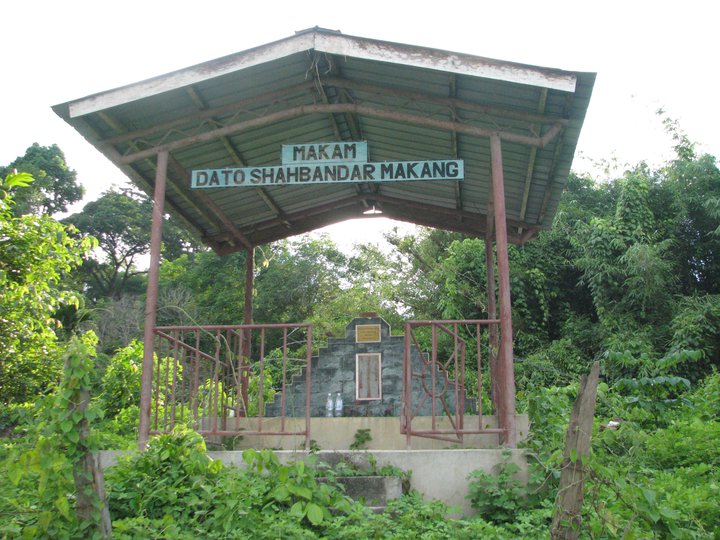
 “Who was Dato Shah Bandar Foo Mah Kang?” My nephew, Justin Wong, wants to know. He found the man’s grave somewhere in Kuala Penyu and wondered what position this fellow had held that he deserved a grand grave and had a hall named after him.

Picture courtesy of Justin Wong (Click to enlarge)


Long past long ago, before our great-great grandfathers were born, before the White Men knew there was this paradise called Sabah, the Bruneis were lord and master of our land. According to this man named Ranjit Singh, Brunei already established relations with the Middle Kingdom in 518 AD and by the ninth century trade between the two countries had increased.


 Brunei, apparently, was an ideal place because of its good harbour and its location on the ‘shipping routes’… although it also meant Brunei became a regular stop-over for pirates and slave traders from Sulu!


Probably long before the other parts of northern Borneo were peopled, Brunei was already a thriving and civilized city run and administered by a government. I imagine that  the population multiplied and spread along the coasts southwest to Sarawak and northwards to Sabah. There was a need, therefore, to administer the territories—the outstations—outside Brunei proper.


 (Remember, Sarawak—or whatever its ancient name was—had been under Brunei before the Sultan gave away the land to James Brooke as a thank you gift/reward for curbing piracy. Why such a big chunk of territory was given away, leaving a tiny crumb to remain Brunei, nobody has told me… yet. The western part of Sabah was also Brunei land.)


Fast forward to more modern times!

In the 16th and early 17th centuries, Brunei devised a system whereby its territories were divided into jajahan (dependencies) for administrative purposes.

From the 1870s to 1880s Brunei’s principal jajahan were:
Tempasuk
Tuaran
Menggatal
Mengkabong
Inanam
Api-Api
Putatan
Kawang
Panglat (sic)
Papar
Benoni
Kimanis
Bongawan
Membakut
Padas-Klias (Kuala Penyu is here)
Padas-Damit
 
Note: Each jajahan (dependency) was actually the valley/plain through which the river and its tributaries flowed—from the source to the mouth. That’s why the jajahan was also simply called sungai.

Okay, who were the rulers of these dependencies/jajahans/sungais?
 
The rulers and administrators of Brunei consisted of:
I.                   The Sultan or Yang di-Pertuan. He was the supreme authority in the State.
II.                Directly under the Sultan were 4 Ministers of State or Wazir. They were usually chosen from members of the royal family or nobility (Pengiran).
1.      Pengiran Bendahara (Chief Minister)
2.      Pengiran Temenggunng (Minister in-charge-of justice and defence)
3.      Pengiran di-Gadong (Minister of finance)
4.      Pengiran Pemanca (Minister in-charge-of diplomatic affairs)
III.             Ceteria
The highest post is that of Pengiran Syahbandar (Officer in-charge-of commerce)
IV.      Menteri
V.                Community leaders/tribal leaders/village headman (chosen by communities but given official recognition by government)

Now let’s skip back to this territory called jajahan aka sungai.
 
A jajahan was divided into two main categories;

A)    OFFICIAL APPANAGES
i)       sungai kerajaan belonged to the ruler (Sultan) or the Crown
ii)       sungai kuripan belonged to the Wazir--- there were four, remember?

B)    PERSONAL or hereditary domains (or sungai tulin or pesaka)
These were private lands and could be held by the Sultan, Wazir or Pengiran (nobility)

The owner/overlord (a) governed his tulin privately and collected revenues/taxes. He owned both land AND the residents (known as hamba!). The more households in the tulin, the more taxes—which were based on the number of households—could be collected. The Brunei overlords were very smart. They kept track of their hamba so even if the hamba had moved, say from Papar to Putatan, the hamba still paid his poll-tax to Papar!
The owner/overlord also (b) administered the tulin and paid taxes to the Sultan (Crown).

Note: Unlike official appanages, tulins were inheritable and could be bought and sold by local people. Foreign buyers needed consent from the Sultan. (I thought that was very smart.)
 
Now, although the tulins were personal territories of the Sultan, Wazirs or pengirans, these owners lived in the capital (negeri). Maybe living in the outback was no fun… it would be like orang KL transplanted in Tongkod or Ambong or my kampung. So the overlords appointed local people as proxies! Very clever… eat your cake and have it, too. The owners of the tulins ‘remote-controlled’ the local proxies to administer in their absence.

Did the proxies get mad and asked ‘why me?' Why would they when they enjoyed certain perks, were recognized by the government and were conferred titles of Datuk or, the less grand, Orang Kaya? Example: Datuk Amir Bahar of Papar; Datuk Setia of Putatan who was setia to his overlord, Pengiran Muda Tajudin.
 
Not all overlords practised ‘remote-control’ from Brunei/the capital/negeri. The Mengkabong overlord, Pengiran Abdul Rauf administered his jajahan himself. He also had officers under him: Datuk Bandar, Datuk Temenggung, Datuk Pemanca, Orang Kaya Laksmana.

Grave of Dato Shah Bandar Foo Mah Kang. (Courtesy of Justin Wong)

So who was Dato Shah Bandar Foo Mah Kang (1808 – 1876) of Kuala Penyu?
He was probably a local resident who was chosen by the community or appointed by the overlord of the tulin Padas-Klias (who happened to be Sultan Abdul Mumin in the 1870s) to be in-charge-of commerce… the equivalent of present-day Minister of Trade and Commerce? Town Mayor? 
 
Such a long answer to a short question!

p.s. Please leave comments if there's more to add about jajahan and Brunei rulers and especially if I've said something incorrect. Thank you! 


Thursday, March 24, 2011

But Some Men Are More Equal Than others

Writing the previous post has dredged up memories buried deep under years’ worth of mental clutter. I have almost forgotten some of them but somehow reading the comments posted by Gunaqz and the others have cracked a hair-fine opening in my subconscious mind and some memories fought their way to the surface like dying worms gasping for air.

I remember the stories my daughter brought home from school along with her artwork and yellow confetti to stick on mother’s day cards. What she and her schoolmates saw during those terrifying days were not fit for kids’ eyes. One such story was about a mother who went to take her kid home from the kindergarten across the girls’ school. (Or was it a teacher bringing a pupil home?) She had almost reached her car when one of the men-in-black-with-red-around-the-head dragged her roughly to the bushes. What did he do to the poor woman?

His atrocity made the teacher tell the little girls in my daughter’s class to “Don’t look! Don’t look! It’s a sin to look!”  To make sure they didn’t look, she made them put their heads on their desks… like playing a game and they’d become the ‘it’ counting to ten while their friends hid behind walls and cupboards. Except that day it wasn’t a game.

Mr. Hubby had to pass the road near the Telekom buildings (between Sacred Heart, the boys’ school, and Wisma Kewangan) and he was assaulted, as were the other vehicles, with a hail of fist-sized rocks raining down from the high ground skirting the road. One hit the roof of his car, narrowly missing the back screen, and left a deep dent. Some vehicles weren't so lucky.

My school, unfortunately, wasn’t spared from a bomb scare.


One day the principal ordered all the students and teachers to vacate the school buildings and line up at the padang before announcing that he had received a message:

A bomb placed in one of the 30-odd classrooms was about to explode.

After we—the class teachers had made sure that none of the students in our respective classes was missing—we were ordered to go to our own classrooms to hunt for the bomb! No bomb squad was called. The police didn’t even come. We were stupid enough to follow the order and risk our lives.

It was only later—after all the drama and hysterics— we were told the bomb-in-the-classroom message had been a hoax sent by a student who thought he had the perfect opportunity to get even with the school authorities for taking disciplinary actions against him.
Image from Asiaweek

In Tanjung Aru, where the demonstrators gathered after they had walked all the way from the Town Padang, bombs were planted in dusbins and staircases. One exploded on a five-foot way killing a Chinese gentleman. Poor fellow. He was just an innocent passer-by caught at the wrong place at the wrong time.

My friends and I learnt to stay away from garbage bins for fear of planted bombs. In fact, for a long time we didn’t go anywhere at all. I was either at home or at school. We ventured to town only when it was absolutely necessary.

Later, days later, after the damage had been done; after all the not-peaceful demonstrations, the bomb explosions, the arsons, the threats and more, the Federal government shuffled in (half-heartedly? unwillingly?) to help restore law and order.
Image from Asiaweek

KK turned into some alien place where FRU personnel mingled with the shoppers in the corridors and five-foot ways, their fingers on the trigger of their M16 machine guns. (We added new phrases to our vocabulary: federal reserve unit, M16.) It was the first time I saw a real machine gun but instead of making me feel safe, it made me nervous and jittery. What if the fellow pulled the trigger accidentally? What if an accident started a stampede?

A curfew was imposed. No one was allowed out from 6pm to dawn. My SIL was caught driving along the deserted Penampang road. She was stopped and questioned by the gun-toting police.


We, the ordinary, law-abiding people had been caught in the crossfire between the lawfully elected and those who’d sell their souls to the devil in exchange for the power to run the state. There has to be some incredible personal satisfaction or reward one could get just by holding a minister’s post or having a ministerial portfolio.

Some people serve their God and country by being the best stay-at-home moms; some by being farmers, shopkeepers, doctors, dustmen. Or, like me, teachers. Others must be ministers in the state cabinet or in parliament, or else… They cannot serve their God and country any other way. Go figure…

Pictures from Google Images