Showing posts with label Dusun. Show all posts

Sunday, May 24, 2015

Pangi

The Dusuns have been using pangi (kepayang in Malay) as a food preservative for generations. I’ve known this nut since childhood because my mother also used it to make daat—a fish pickle. Therefore, I was surprised to learn, a few years ago, that the pangi is poisonous unless prepared in a certain way to rid it of toxins before adding it to the cooking pot.

In the old days, before the advent of refrigerators, meat and fish were preserved by salting them before putting them under the sun until they were bone-dry. They could also be preserved by smoking or by pickling, or by covering the sliced meat or fish pieces all over with the pounded flesh of the pangi nuts (Pangium edule) before drying them under the sun.


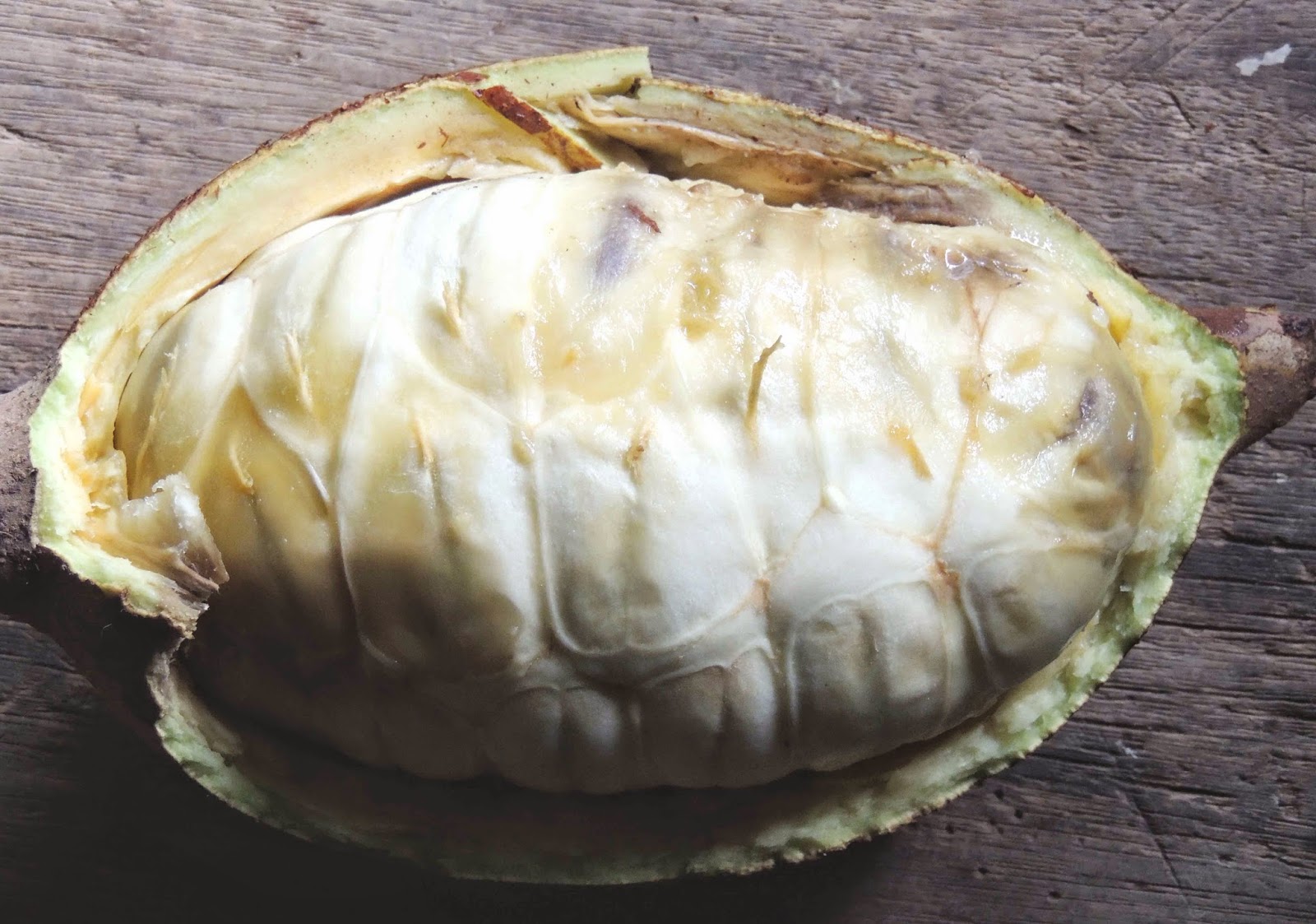
The nuts come from the pangi tree which grows wild in the kampungs. Until several years ago, despite living my childhood in the kampung, I thought the pangi nuts hung from branches just like rambutans or sour limes. Imagine my surprise when I saw my first pangi pod!


Not many people are aware that the nuts are contained in a pod because what they see for sale at the tamu are the individual nuts after their ‘housing’ has been removed and discarded.

The mature pangi tree measures about 50 to 60 feet in height. Pods hang individually or in clusters on the branches high above the ground. People tend to mistake the pods for the more familiar bambangan as both occur in the same shade of brown. However, closer inspection will show that the skin of the pangi pod is covered with tiny raised spots and it feels rough to the touch. The bambangan is smoother and unlike the pangi pod, it is rounded. The pangi looks as though two hands have pulled it by the stalk and lower end resulting in a shape more longish than round. The pulling has also left a ‘nipple’ on the lower end. This is absent in the bambangan.


Peeling the skin of the pangi pod, (which falls from the branch when it matures,) will reveal rows of nuts arranged neatly in tight rows. The nuts are covered with pale cream-coloured, sweet pith that is stuck to the nut and is difficult to remove. Cows are fond of the sweet, sticky pith. They eat it and they swallow the nuts whole and thus help in seed dispersal.

The pictures show a pangi pod with the top half of the peel cut away. Since it was difficult to remove the pith without disturbing the nuts, I left the pod under the sun for several days. The pith dried up slowly to reveal the nuts packed in tight rows. 


Saturday, August 04, 2012

A Living Fossil


The Cycad (Click on pic to enlarge)

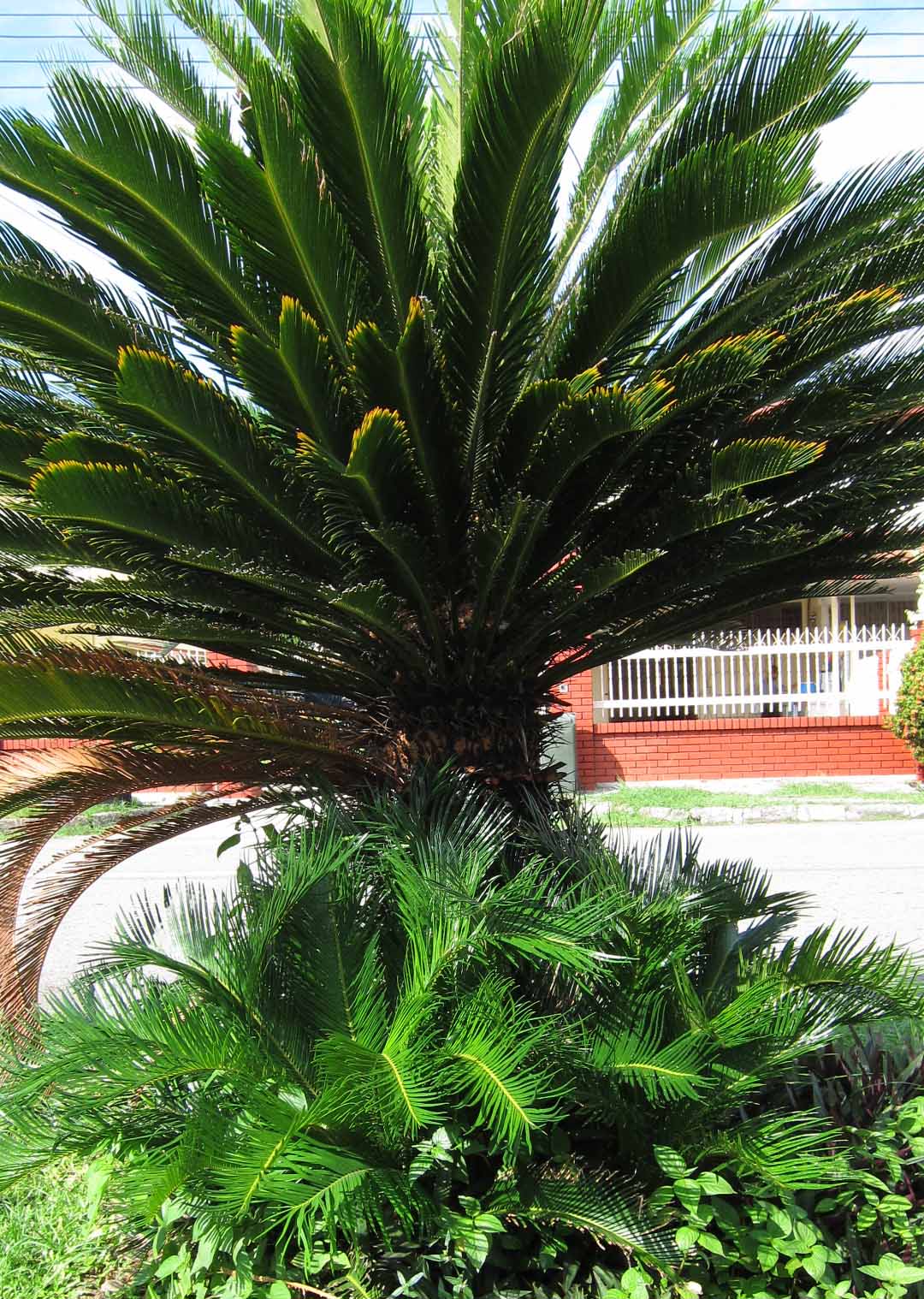
The Dusun call this plant Tugu or Potugu while the Malay name is Paku Laut. The trunk looks like that of a fern tree and the leaves resemble palm leaves. But it is neither a fern tree nor a palm tree. This is the Cycad and because it produces cones, it is actually a pine tree.
The leaves appear in whorls around the trunk

The Cycad is a descendant of ‘gymnosperm’ which existed 270 million years ago. It is as old as the dinosaur—making it a living fossil! Today it thrives mostly in dry and arid areas in tropical and equatorial regions. They’re hardy plants and according to Ms. A Phillips, an ecologist with Sabah Parks, Cycads have no known predators except a kind of butterfly known as Cycad Blue. The larvae of these butterflies feed on the tender, young leaves. When this happens often enough the tree could die.
The larvae of the Cycad Blue feed on the young leaves.

Perhaps unknown to many people, the Dusuns of the old days were another group of predators! My mother told me that the young leaves are edible and they were picked and cooked as a vegetable. Of course I thought she must have been mistaken. But that was before I saw what was captioned next to a Cycad at the State Museum!
Notes about the Cycad

In KK the Cycad plants are used in landscaping and as ornamental trees on road dividers and roundabouts. I’ve planted one tree at the roadside in front of my house. (That’s Mr. Hubby’s house if you’ve been following this blog.) When I turned the hose on it the other day a grayish cloud burst from the upper leaves. The ‘cloud’ was actually hundreds of butterflies escaping from the water.
One of the butterflies flying among the leaves

Baby plants


A few baby plants are growing below my 25-year-old Cycad. I’ve mentioned to friends that I’m giving them away. There have been no takers yet. So who wants to plant and help preserve a living fossil?

Thursday, May 17, 2012

The Wild Men of Borneo


Ugly? The Dusuns? Yes, according to the author of With the Wild Men of Borneo (Published 1922). I could have blown a fuse if I had not thought Ms Mershon’s opinion hilarious!

 Was she really talking about us, the Dusuns? Had she really seen at least a few Dusuns face to face before she pronounced our ancestors ugly? Or did she imagine that we looked like Waino and Plutanor aka the 'Wild Men of Borneo'? Incidentally, these 40-inch tall gentlemen were actually Hiram and Barney Davis, two mentally disabled brothers who captivated gawkers with their feats of strength in the 1850s. They were said to be from Borneo but they were actually from a farm in… Ohio!
Hiram and Barney Davis (Google Image)

Anyway, back to this book…
Click on picture for larger image.

When the author came to North Borneo with her missionary husband she said—at the beginning of her book—“All I knew about the country was that it was where the wild men lived, and I always imagined that they spent most of their time running around the island cutting off people’s heads.”

Despite the derogatory remarks and the harsh words she used to describe the natives, it’s an informative book and tells about her boat trip and what life was like in Sandakan in the earlier part of the 1900s. However, I must tell readers that what the writer said about the Dusuns being ugly is not quite correct. Perhaps the writer’s declaration was coloured by prejudice or ignorance? 

Those days we were not ‘civilize’ if being civilized meant living, dressing and eating like the people in western countries. Okay, we were illiterate but illiteracy doesn’t make one ugly, does it? Until the first schools were established around 1900, kids didn’t go to school in NB. Many foreigners must have assumed our ancestors were savages living in the land of the lawless. Wrong. They observed rules. There were taboos. There were laws to live by.
Dusun maidens at the tamu. (V.Wah)

If our ancestors went around with their bodies barely covered in sarongs and loin cloths, it was probably because that was how they dressed to beat the hot weather. And perhaps woven fabric was scarce too… and therefore, expensive or reserved for special occasions.  Now it’s common to see people—whose civilizations are older and much, much more sophisticated than ours—braving their cold weathers dressed in barely-there garments. We may wonder at their ‘hardiness’ but we don’t criticize them. Of course, some people—like my mother who doesn’t know any better—would say, “What a shame! They must be too poor to buy decent clothes.”
Dusun girls (Photo: D.Lau)

As a community our ancestors were known to be gentle, hardworking and honest. They  looked out for one another and were civil to all… except when face to face with members of enemy tribes. In such situations our ancestors took great delight in chopping the heads off their owners’ shoulders. It was a form of sports, this removing of heads, an opportunity to collect trophies and later (having preserved said trophies by smoking!) show them off—as Stephen Holley found out when he was a District Officer in NB!

However, our ancestors didn’t “spend most of their time running around the island cutting off people’s heads.” They had to grow their own food, go hunting and fishing, clear land for agriculture, have parties and celebrations, take care of their kids, they communicated with the spirits…you know, the usual stuff people in other cultures did or are doing…except the Dusuns didn’t go chasing other people’s spouses. That was strictly forbidden and fines were imposed on those who lusted and ran after other people’s wives or husbands.

What did the British think about the Dusuns back in the 1880s? Let me conclude with an excerpt from the North Borneo Herald (1 September 1888), the fortnightly newspaper:
Dusun girls circa 1915 (Oscar Cook)

“Within the limit of each tribe crime is unknown. All are equal—none are wealthy, none are absolutely in want, each one with aid of hardworking wife and kids, provides with his own hands the family’s requirements. Land yields rice, tapioca and surplus goes to the pigs beneath the house. Close to the house—garden with tobacco, betel-nut for enjoyment of all including the children; kapok tree furnishes cotton which women deftly weave into durable sarong and waist clothes. For every man there is a wife, for every woman a husband. Among such a people the passions of envy, covetousness and lust, which are the source of crimes, which law has to check and punish, do not exist. There is, however, a passion which appears to be implanted in the whole human race, from what we deem the highest and most civilized to the lowest and most barbarous. This is the savage delight of shedding man’s blood. This passion exists equally in the Dusun…”  

Friday, July 29, 2011

Dusun Snacks

The snacks my siblings and I had in the days of yore were a far cry from what today’s kids enjoy. Even something like ice-cream—unless it was the orange squash-flavoured- hard-lump-of-ice variety—was beyond our means. Now that doesn’t mean I felt poor or deprived. In fact, I was only aware of my ‘poverty’ when I went to school which was in the big town of Jesselton and two hours away by Land Rover.

From Google Images

In the kampong, everyone seemed to be equal. Same old, rickety, bamboo houses with palm-leaf roofs; same patched-up old clothes; same bare feet with soles thickened through miles of walking bare-foot; similar number of pigs, piglets and chickens and the must-have one or two buffaloes. Maybe part of the reason why we kampong flocks got on exceedingly well together was because there was no envy among us. There was nothing to be envious about—unless you talked about some neighbour who had a bountiful harvest of paddy while your paddy became food for the birds… which was quite possible if you didn’t put up scarecrows or you habitually woke up after the flocks had eaten their breakfast. If laziness had been the cause of your misfortune, you might as well swallow your complaints because you’d get no sympathy from your neighbours!
 
 Growing up I learned that, unlike the Bajau in the kampongs around Kota Belud, the Dusun in my village didn’t make fancy cakes or snacks. Fruit trees were abundant and we ate the ripe fruits—nangko, timadang, punti, pulutan,—without turning them into fritters like other people did. Edible roots—yam, tapioca, sweet potato—were simply boiled or toasted over some burning embers.


From Google Images

Most of our snacks, however, had rice as the main ingredient. I remember we made ‘lompuka’—steamed cakes wrapped in leaves—using grated tapioca or pounded pulut rice (topilit to us) that had been soaked overnight. There wasn’t anything simpler than making these cakes. A fistful of pounded rice, or grated tapioca, was carefully wrapped in a square of banana leaf before each flattened, palm-size cake was arranged in layers one on top of the other in a big pot. After pouring a little water into the pot, it was put over the fire to boil for several minutes. Many people served lompuka during weddings.
 
 In the old days, when the rice grains were still young, it was common practice for people to pluck a stalk of paddy while walking through the fields and removing the husk of each grain before popping it into the mouth—much like eating sunflower seeds. When chewed, the young rice grains burst and filled one’s mouth with a sweet, milky juice which to us tasted heavenly! Coming home from wherever our errands had taken us, we’d have a few of these rice stalks with uneaten grains and they had to be fed to the chickens (instead of left lying around or thrown away) so we'd avoid offending the rice spirit.


From Google Images

Another popular snack was natah—or was it matah?  The young, still-green rice grains were gathered, and ‘stir-fried’ in a dry wok which, incidentally, we call poriuk. Many of the grains would pop, just like pop-corn. Then this ‘fried’ paddy would be pounded to get rid of the husks. The chaff was removed by placing the pounded rice in a nurod and by throwing it up into the air repeatedly and catching the grains as they fell, the light husks were blown away and heavier grains remained in the nurod. Heating the grains in the poriuk made the natah smell very fragrant. This was one snack and we enjoyed by the handful.


We could also change the taste and texture of the natah by putting the fragrant rice into a young coconut so it absorbed the sweetness of the coconut juice and turned into moist, fat grains.

Then there was sweet tapai. In the good old days, I made sweet tapai with the same sasad (yeast) we used for the beer tapai. These days I buy my yeast from a vegetable vendor at the Donggongon Tamu. He says he’s from Kota Belud but the yeast is from Tawau. The tapai made with this yeast is very sweet and I’ve wondered what the pellets contain.
 

The yeast costs RM2,00 at the Donggongon Tamu


Anyway, this is how I make my sweet tapai. No secret recipe. Verone? I hope you’re reading this.
I use left-over rice so it doesn’t go to waste and I don’t have to throw it away and risk offending Bambarayon, the rice spirit.

 
One pellet of yeast and one big plate of cold rice 

For a plateful of rice I use one pellet of yeast. You can have double this amount of rice and let it ferment longer… like two days.

Spread yeast evenly.


Because I’m lazy (don’t tell my mama!) and like to take short-cuts, I use a plastic strainer to rub the yeast and let the ‘dust’ fall onto the rice.
You should stir the rice to spread the yeast evenly.
 
Any container with a tight lid is fine.


Put in a container, close lid tightly and let it sit for one or two days. After it has fermented you can put it in the fridge so you can enjoy cold, sweet tapai!


 Murid-murid, ada soalan?? 


No questions? Good. I’ve one for you. Assuming that your parents, (or grandparents *ouch!* ) are around my age, what were their favourite snacks when they were children?


Here’s to (holding up a mug of tapai) wriggling butods, toasted crickets and succulent frogs’ legs!

Saturday, July 23, 2011

Frank Hatton: Blood Brother to the Dusun

If you had lived a hundred and fifty years ago and you had one precious son, would you have let him leave the comfort of your home to work in the land of the headhunters and pirates?

The doting parents of a boy, barely out of his teens, did just that. They released their only son (albeit reluctantly) to sail half-way round the world and live in the land they knew only as a spot on a map.

The boy, Frank Hatton, was born in England on 31 August 1861. As a child he had wanted to be an engine-driver but he became an outstanding scientist instead and was made an Associate of Chemistry and a Fellow of the Chemical Society by the time he was twenty.

And by the time he had turned twenty, he had left his anxious family to become a blood brother to an unknown people (savages to them) in a faraway country.  


He had turned down the opportunity to work as assistant chemist at Guys Hospital in London and accepted an offer from Alfred Dent. It was the post of mineral explorer and metallurgical chemist. That was how he found himself in the equatorial jungle of Sabah in 1881.

Hatton had a flair for languages and learnt flawless French when his father sent him to study for two years in France. He displayed this same trait in Sabah, learning to read and write Malay and various Dusun dialects. He even compiled a comprehensive Dusun dictionary with the aim of publishing it.

The ‘mineral survey’ took him to the east coast of Sabah where he undertook journeys of exploration. In 1882 he surveyed the entire Labuk River and its tributaries, from the estuary right to its source in Mount Kinabalu.

He found very little evidence of minerals apart from coal but he found friendship among the Dusuns who, although Frank must have been the first white man they had ever seen,   embraced him and made him one of them in ceremonies conducted with traditional rites. In a letter to his father he told about being made a blood brother in five villages and that 300 spears would readily come if he needed help!

In 1883 while Hatton and his party were turning back from an aborted expedition—it was the wet season and very swampy—to discover the source of gold in the Segama, Hatton spotted an elephant. He shot at it but only succeeded in wounding the animal. The men gave chase and it was dark when Hatton called off the hunt. Going back to their camp, he used his rifle, holding it by the barrel, to clear a path. Unfortunately, he stumbled and the rifle discharged and shot him on the upper chest (probably puncturing a lung.) His party was 160 km up the Kinabatangan. The nearest hospital was 270 km away. The party paddled day and night for 53 hours so Hatton could be buried in Elopura by white men.

A funeral service was held in his house before he was buried on the side of a hill. He was   the first European to be buried in Sandakan. He was only twenty-two.

Back at his home in England, his parents had been aware that the gold-prospecting expedition was to be his last before he went on leave. He had hoped that on his return to Sabah he would be appointed Resident.

His parents had been eagerly awaiting his return when they received the devastating news of his death from William Crocker (after whom the Crocker Range was named).

After his death his father wrote a book—“a tribute from a loving father to a devoted son”—in which he included the latter’s letters home and materials from his diaries and notes. The  father said: “I had my reward in a brave, upright, modest, scholarly son, to whom I hoped to have bequeathed my name and the care of his mother and sisters. We had all come to regard him as the prop of our small house and I knew that he was of the stuff that great men are made.” The senior Hatton added that he “could have been content to lay aside my work and have for my epitaph: He was the father and friend of Frank Hatton.”

During his short life, Frank Hatton had been a brilliant scientist, a great linguist, a gifted musician and, judging by the natives’ high regard for him, a lover of human beings.

We could only guess at what this brave, selfless man would have been able to accomplish for Sabah if not for his untimely death. And we could only regret that our own posse of leaders does not have a fraction of his brilliance or an iota of his humanity. (Wasn’t that People-First slogan just crap cooked up by desperate clowns?)

So, would you have sent your son to Borneo like the Hattons did?

I’ll let Frank Hatton have the last word: “It is the duty of everyone to see as much of the world, and to do as much in it as is possible in the short time allotted to us.”


Ref:
North Borneo: Explorations and Adventures on The Equator (Joseph Hatton)
Blood Brothers (Lynette Silver)
 
Pictures from Blood Brothers

Friday, July 01, 2011

Before the White Men Came

Another short history lesson… tralala...  What was life like for the Dusun on the east coast of Sabah about  two centuries ago?

While the west coast of Sabah was Brunei’s jajahan (dependencies), the east coast came under the influence of the Sulu Sultanate from late 18th century to the 19th century.

Because of regular and widespread flooding of the big rivers on the east coast—the Segama, Kinabatangan, Sugut, Labuk, Paitan—the Dusun* avoided the flood-prone plains on the lower courses of the rivers, the river mouths and the fertile deltas. Instead they settled in the middle and upper courses, practiced shifting cultivation and planted hill paddy.

*Ranjit Singh used ‘Kadazandusun’ which is a recent tag and FYI, I don’t quite subscribe to it because ‘Kadazan’ denotes the indigenous people of Penampang and Papar while ‘Dusun’ the other regions of Sabah. Example: Dusun Tindal of the Tempasuk region, Dusun Lotud of Tuaran, Dusun Rungus of Kudat, etc.

Dusun girls (Oscar Cook)
Probably an important reason for keeping to the upper courses of the rivers (as pointed out by the author of ‘Blood Brothers’) was to avoid pirates who frequently raided villages situated along the lower courses in search of booty and slaves.

I imagine the Dusun working hard and living simply but contentedly in small communities along the upper courses of the rivers. All their needs were within reach in the virgin jungles around them: animals for food and game, edible jungle greens, building materials, etc. Well, maybe they’d miss salt which of course they couldn’t pluck from the forest but it was easily obtainable from the coastal areas. All they needed to do was row down the river ‘highways’ which were navigable for long distances upstream. The forests were excellent sources of jungle produce such as damar, rattan, camphor, bees’ wax, gutta percha. And these could be brought downstream in exchange for salt, fabric, jars and other ‘luxuries’ from Suluk traders.

Traders from Sulu discovered that by playing middlemen, they made handsome profits when they brought Chinese jars, brass gongs, cloth to the Dusun upriver in exchange for the jungle produce which were much sought-after by the Chinese.

The jungle produce were shipped to Jolo (pronounced Holo!) which was the last port of call for the Chinese junks on their annual route to the eastern flank of Borneo.

Tapping damar (Google Images)
From the late 18th century there was an upsurge of trading activity in Jolo because European ships began to call at Jolo (where the Sultan of Sulu was based) to acquire goods to trade with China. Jolo was becoming an important commercial centre! Now, if you had been the Sultan of Sulu, what would you have done? Why, get more goods for the Chinese, of course! More forest produce meant more trading and, therefore, accumulating more wealth.

Suddenly, the east coast of Sabah became an important source of income—free durian runtuh from the forest and the sea (because Sabah was rich in both forest and marine produce.) The Sulu Sultanate could not touch the west coast because that was Brunei jajahan.

Suddenly, waiting for the Dusun to supply the forest produce was too slow and the consignments too small to meet demands. Unlike the Brunei overlords, the Sulu Sultan did not appoint local proxies to oversee the collection of stuff from Sabah. He appointed Suluk datus/aristocrats as governors. He chose datus who had local family ties and strong personal influence in Sabah.

Google Images
The datus/governors’ job: to open up settlements on the east coast and take care of economic activities—mainly collecting forest produce, pearl fishing, collecting marine produce.

So from the late 18th century, Suluk settlements (sponsored by the Sulu Sultanate) sprouted like mushrooms at strategic locations on the lower courses of the great rivers. The majority of the people in these settlements were Bajau. They were not there to open up the land for agriculture. They were there to harvest natural resources from Sabah’s rich forests and waters and bring the goodies to Jolo! They didn’t have to wait for the Dusun to bring the forest produce downriver. They organized their own expeditions (some taking as long as a month) to collect the jungle produce themselves. Maybe ‘plunder’ is too harsh a word, huh? (Damn, for some reason the word ‘petroleum’ in blood-red capital letters is blinking in my head.)

Anyway, the Bajau population in the new settlements was too small to support the economic activities. More people were needed for labour so the Suluks did what they knew best. (Ref: The Pirate Wind)

They went on large scale slave-raiding expeditions! Hapless people/farmers/fishermen were snatched off the coasts of the Philippines, Borneo and even New Guniea—the natives of NG were a ‘novelty’ with their frizzy hair and whatnot—and all captives were taken to Jolo, the collection centre, and sold as slaves.  Many of them ended up labouring in the Suluk datus/governors’ economic enterprises on the east coast of Sabah.

Men from Sulu (Google Images)
The Sultan gave free rein (complete freedom bah!) to the Suluk datus/governors to do what they pleased as long as they:


Transmitted to the Sultan his share of the royalties.

Gave the Sultan the 10% import tax levied in his name.

Ensured that all marine and jungle produce were shipped to Jolo.

Just like today’s rich who become richer through ingenuity and blahblahblah, those days the Suluk datus/governors accumulated wealth through shrewdness and craft.

One method was to introduce their own taxes by controlling the traffic which went up and down the river. Imagine our modern-day roads where you must get a ticket to enter certain routes and pay a fee at a booth on your way out. Well, those days the rivers were highways and the datus/governors set up custom houses (similar to our modern ‘toll’ booths) along the rivers. A bamboo or rattan slung across the river was lifted after the boat owner had paid a duty. No pay, no entry! Clever, eh?

Old Chinese jar (Google Images)
The datus/governors also imposed ‘sarar’ which was a system of ‘forced trade’ whereby village folks were forced to buy, say a Chinese jar or a gong or cloth, at sky-high/tak berbaloi prices to be paid with a certain amount of jungle produce—even though the villagers had not wanted the merchandise in the first place. (Hmmm, how come I’m thinking of that damn email thing which everyone above eighteen is supposed to get?)

The governors were also free to conduct slave trading and raiding activities. It was perfectly legal for them to pluck any Pacik, Gaman and Sumandak, to sell as slaves or to turn into slaves, and to raid and plunder villages.

On the west coast each household had to pay poll taxes to their Brunei overlords. On the east coast the Dusun communities lived in fear of plundering pirates and bullying traders. Was it a wonder that parents insisted their prospective sons-in-law had human heads to prove their bravery?

Now you’ll understand why many of the Dusun people did not fight against the white men when the latter came, especially when the British Crown, among other conditions, specified that the British North Borneo Chartered Company must ‘abolish slavery, administer justice and law in concurrence with native laws and respect religion and customs of the local people’. (Blood Brothers)

Okay, end of lesson. In case you’ve anything to add or share, please feel free to leave your comments!

Ref: The Pirate Wind, The Making of Sabah, Blood Brothers.

Monday, November 29, 2010

Returning to the Mountain

Mount Kinabalu is sacred to the Dusun communities. Gayoh Ngaran or Big Name, as the mountain is known to the Dusun, is our final resting place.

In the old days, the Dusun could hunt on the mountain and take rattan and other forest produce from the foothills. Then the white men came. They wanted to protect the mountain they said. Because everybody recognized that the mountain was sacred to the Dusun, the British officers came, along with the local authorities, and talked with the Dusun Elders from the villages on the foothills of the mountain.

The Dusun agreed to ‘give up’ the mountain as part of the park. They wanted very little in return. Only three things: they’d be allowed to continue to collect rattan; to collect forest produce; and to hunt on their ancestral ground. The authorities agreed to the requests. But in 1964 the mountain was gazetted as Kinabalu National Park. A strict ban was imposed and the villagers found that their requests had been ‘withdrawn’. The Dusun people lost their ancestral access to the mountain. There was to be no more collecting of rattan, or jungle produce. No more hunting.

Kinabalu was declared a World Heritage site a decade ago. Lured by its beauty and biodiversity, the number of  visitors has continued to increase. Last year a quarter million people, from all over the world, visited the park and of these 27,000 were willing to part with a hefty sum to experience the climb. The mountain has become a must-visit destination for paying tourists.

To the Dusun villagers it looked as though only their souls would ever reach the peak. The climbing fees are way beyond their means. Only the Dusun guides and porters have the opportunity to go up the mountain for free.

Dusun porters around 1916,  Oscar Cook
Perhaps the Dusun Elders didn’t know what they were giving up when the authorities came to talk? Perhaps nobody told them to read the fine prints? Or maybe the fine prints were added later, much later.

 For the last 50 years the Dusun Elders could only lament about how things used to be. They could only feel regret and sorrow that their own communities have no opportunity to visit the mountain.

So in March 2010, the Dusun Elders from the foothills of this majestic mountain spoke to park authorities about their great sadness and said:

"... we do not want the mountain back. It is a heritage for the world, and for that, we are proud and happy to share this mountain with everyone."

Dusun girls (Google Images)
"There is only one thing that we want."

"We would like to have one day to return to the mountain."

"Every year, each year, we want to have one day just for our communities to make a pilgrimage to the mountain. A day when no one else will be allowed to climb the mountain. A day just for our people."


The Sabah Parks Deputy Director was there and he agreed to their request.

The Return to the Mountain will take place on 3 Dec 2010. On this day, 125 community members from the villages of Kiau and Bundu Tuhan will conduct a pilgrimage to Mount Kinabalu.  The monolob ritual will be performed early in the morning. A traditional priest will slaughter seven white chickens as an offering and to seek permission from the spirits to climb the mountain. Then community members will begin their journey—a return to their mountain.

This day is going to go down in history as ‘the day the Dusun people returned to the mountain’ or Kakakapan id Gayo Ngaran.

Source: Daily Express

Thursday, September 30, 2010

Who says Dusun weddings are black and white?

My nephew’s wedding was celebrated last weekend. The occasion was another opportunity to meet with the clan and renew family ties with seldom-seen, almost forgotten, distant relatives. It was also the time to show off the Dusun traditional costumes of Kota Belud.

And what a colourful show it was!

The bridal couple arrived, glittering in their fineries, a fancy umbrella held high over their heads during the five-second stroll from the car to the house! The word ‘fancy’ doesn’t really describe the umbrellas which had been painstakingly re-done in egg-yolk yellow and decorated with zigzags, geometrical motifs and a tasseled zigzagged hem.

The Dusuns of yore used these umbrellas? Probably the idea, if not the contraptions, was borrowed from the Bajaus!

The actual marriage ceremony has been modernized. Bride and groom read their vows and promised to have and to hold, and all that stuff, from a prepared script… in the presence of the Headman and in front of everybody.


During my mother’s time (and when I was a kid) the bride was nowhere to be seen at her own wedding! I had asked my mother why the bride was hidden from view but her answer hadn’t been very helpful: Yo no loh mogiponou yo. ‘That was what it was like when people got married.’ See? I told you she wasn’t helpful!

Another thing I remember, in the old days, the bride arrived at the groom’s with an embroidered, black hood over her head… not a decorated umbrella. And she had to walk of course, used her own two legs. Why wasn’t a buffalo used to carry the bride, you say? Well, as far as I know, buffaloes were used only to work in the paddy fields. The people probably didn’t want to burden them (buffaloes) with extra duties such as transporting brides to the grooms. But we’re taking the wrong turning here. I want to tell you about the wedding costumes.

W-e-d-d-i-n-g… I’ve to make sure I spelt that correctly because several times I’ve come across people writing about the weeding they attended. You’d think they went weeding in their paddy fields instead of going to make merry at a wedding. Tsk-tsk-tsk…

Anyway, the wedding costumes are elaborate and colourful and many of us don’t even know what some of the objects are called. They have become so rare and expensive that most Dusuns just opt to wear jackets and gowns for their weddings.

As you can see from the picture below, I’ve tried to label the wedding attires and accessories but I’m a novice at Paint, hence that blue line which refused to be replaced with yellow.


                                                          (Click on photo to enlarge)
Glossary

Sinipak: black velvet blouse; the sleeve is slashed at the elbow where coloured layers of cloth are inserted. An embroidered panel (linangkit) with silver trimming is sewn above the elbow. The groom wears the sinipak over a long-sleeved white shirt.

Gonob: The bride’s knee-length, black skirt which has embroidery of yellow, white, red and green along the hems and seams.

Seluwar: Traditional trousers, black and with a very wide waist

Sigar: Male headwear made of hand-woven material using fibres from a kind of banana tree.

Sunduk: Bride’s black, embroidered hood

Lolopot: Two folded kain dastar (similar to male headwear) placed diagonally over the chest and secured at the waist. At the shoulders, the corners are left to jut out so they resemble collars.


Barantina: Belt made of huge silver coins

Simpogot: Ornaments made of connected silver coins worn below the barantina. The number of coins hints at the wealth of the wearer.

Sinuhudan: Rows of antique beads strung on strings and worn one above the other (like a fitted girdle) on the hips

Kuapu/kiupu: Little tobacco containers of silver decorated with engravings. Three or four are hung on a silver chain and worn around the neck.

Saring pirok: Engraved silver bangles


Note: I have taken care to use the ‘correct’ names but please check other sources…I hope a Dusun costume ‘expert’ stumbles onto this page and helps to enlighten us all!


(Sorry, the post is less than satisfactory. Still learning!)