Showing posts with label Sabah. Show all posts

Wednesday, August 31, 2016

Merdeka! Merdeka! Merdeka!

(Reproducing a post I wrote on 31 August 2010…)

People are shouting ‘Merdeka!’ and enjoying the public holiday. Another day off from work. While I sit at home and watch the celebrations on TV, I can’t help feeling somewhat peeved that the announcers and the people being interviewed on TV keep repeating that Malaysia is celebrating her 53rd year of independence.


Fifty-three years? Hellooo? Malaysia was formed on 16 September 1963, just forty-seven years ago. Unless you, my dear reader, have also forgotten how to count, know this: what the country is celebrating with shouts of ‘Merdeka!’ is the independence of Malaya from British rule on 31 August 1957. Fifty-three years ago.


Sabah, the ‘Land Below the Wind’, was given self-rule by the British on 31 August 1963, forty-seven years ago. And exactly 16 days later, on 16 September 1963, Sabah, together with Sarawak, Singapore and Malaya united to form Malaysia. I was at the celebration parade at the Town Padang on that day. I heard the proclamation of independence read by Donald Stephens who became Sabah’s first CM. Tun Abdul Razak, the deputy PM was there. But the Tunku, the PM of Malaya was busy elsewhere.

For 46 years, no importance was placed on the anniversary of the formation of Malaysia. Only Sabah celebrated this day without fail… as Malaysia Day and also the birthday of the TYT. I am told that even the date is not recorded in students’ textbooks. It is as though some people want to mislead the younger generations into thinking that Sabah joined Malaysia, a nation that was already in existence. Wrong!


Now, suddenly someone at the federal level woke up/wised up and has called for a celebration on 16 September starting this year (2010). Better late than never, you say? I smell a rat. Sorry.

Moral: If you tell the truth from the beginning, you don't have to resort to creating lies to support the first lie or omission.

I have a list of wishes for our country:

1. I wish for exemplary leaders; leaders we can be proud of and for whom we’d go that extra mile.
2. I wish for Malaysians to look beyond their fellow Malaysians’ races and religions and know that we are all for peace, health and prosperity.
3. I wish for people to be kinder, more generous and more charitable to one another.
4. I wish that Malaysians will not follow each other blindly especially when passing on opinions or information that might not be true. In situations where the blind lead the blind, ‘they all fall into the ditch together’.
5. I wish that the day will dawn when we’d fill a form that requires just our nationality instead of the options: Malay… Indian… Chinese… Others. (I am not ‘Others’ and so are countless like me in Sabah, Sarawak; and the Peranakans, Orang Asli, etc of Malaya.)
6. I wish that the government takes care of our destitute before helping the poor in distant countries.

God bless Malaysia.

What are your wishes for our country?

Friday, October 19, 2012

How many ears must a man have before he can hear people cry?


It is ironical that the government is determined to go ahead with certain mega projects—despite objections from the public—yet turns a deaf ear to pleas for better roads and bridges and other public amenities. Among these proposed projects are a multi-storied shopping mall and hotel on the bluff which is occupied by the 100-year-old Atkinson Clock Tower in KK, and the dams in Kota Belud and Ulu Papar.

You don’t have to travel to remote areas to see that many villages need better roads and bridges. In fact, many of these places have been visited by government officials who came to announce to excited villagers: their dirt road will be upgraded, a bridge will span across the river, they will  enjoy the convenience of piped water to their homes.

However, even simple villagers are now realizing that there are leaders who pretend to listen and do little more than scatter empty promises—like the promise to seal a stretch of track in some Kota Belud village. So enraged were the villagers, when they discovered it was just another empty promise, that when a huge signboard was erected to announce the upgrading of another dirt road they took their axes and parangs and chopped it down. The dirt road was actually sealed after the incident. But could you blame the exasperated people for doing what they did?

How long do these bearers of empty promises expect the rakyat to be patient? Ten years? Twenty? Fifty?
Photo credit: D. Aloysius

What the people want are proper roads, roads on which vehicles could be driven in all weather and not those which magically turn into drains, rivers or buffalo ponds after a five-minute afternoon shower.

The people want good bridges so they could walk without worrying they'd step into a hole or trip on a loose plank. They want safe bridges so their school-going kids would not fall through a man-sized hole and plunge into the river.
Photo credit: 1Suara Sabah
 
Photo credit: 1Suara Sabah

Sky bridge in WMal (Courtesy of D. Dryland)

1926 Keningau (Colonial Office Photographic Collection)


While some places in the country have fancy bridges so tourists could touch the sky and admire the view and treetops, many villages in Sabah have to make do with jambatan gantung some of which are in unimaginable state of disrepair. You’d assume that now we are no longer a colony, we’d have better bridges than we did during those faraway colonial days. But some bridges built during those days could be much superior to those newly built ones, at least in Sabah.


I noted that a jambatan gantung in this village I visited recently was used by many people passing through the area. Is it the only bridge serving the kampung, I wondered. A motor-cyclist had to get off his machine, inspect the bridge before he laboriously took his motor-bike across.

In my own kampung, a wooden bridge built to enable vehicles to cross the river is now barely passable even for us, two-footed beings. Yet this bridge was actually built so tractors could be driven to the paddy fields across the river. Needless to say, no tractors could cross the river today and, judging by the condition of the bridge, no tractor has passed that way for many years already.
My kampung in the news.

A view of the same bridge

Like kids, we’re continually told to be grateful for this, that and more. Be grateful because we have a leader who has the “ability and readiness to listen to the grouses and wants of the people in the State”, someone said in a recent newspaper report.

Well, my dear reader, judge for yourself. Should we be grateful for the crumbs that fall from the table?

My response? Allow me to borrow some words from an old song: “The answer, my friend, is blowing in the wind. The answer is blowing in the wind.”

Wednesday, June 27, 2012

The German Connections


Many of us in Sabah are familiar with the ruins of what was once the magnificent Kinarut Mansion. Built during the years preceding WWI by a German named W. F. C. Asimont and partially demolished by the North Borneo Chartered Company (NBCC) in 1923, the mansion remains shrouded in mystery. Why did the government allow Asimont to build such an imposing dwelling only to destroy it within ten years of its existence?
Kinarut Mansion ruins (Photo credit: Richard Sokial)

Asimont was an expert on rubber and was hired as the first manager of the Kinarut Estate, a rubber plantation owned by a British company called Manchester North Borneo Ltd. It was the second largest rubber estate after Sapong Estate. Asimont was interned during WWI and, apparently, that was the last thing people knew about him. There had been other Germans in NB and they came long before Asimont. Somehow, like Asimont, their stint in NB had been short and—shall we say, disastrous?

Twenty-six years before Mr. Asimont’s sojourn at Kinarut Estate, two Germans—Herman Friedrich Meyerink and Friedrich Hockmeyer—founded the German Borneo Company (GBC) in Germany. The GBC was taking advantage of offers by the NBCC which was eager to attract investors to open up agricultural lands in NB. The German company was offered 10,000 acres for $4,500 at Banguey (Banggi!).
Map of northern Sabah (North Borneo)

H.F. Meyerink and his assistant, Carl Eduard Funcke, arrived in Banguey in 1884 where they established Hacienda Nicolina. Chinese coolies were employed to work on the plantation. However, by mid-year a group of coolies revolted, stole a boat and attempted to escape. Meyerink and his assistant pursued the fleeing coolies and when they were threatened with parangs, the Germans fired several shots. Two men later succumbed to their injuries. The NBCC was blamed for the deaths through its failure to take the wounded to the Kudat Hospital.

Naturally, the NBCC wasn’t too pleased! The company started an investigation which revealed that the coolies were forced to endure bad working and living conditions, ill-treatment by the German managers and Meyerink’s ill-temper. Now it was the Germans’ turn to get upset because they faced ten years in prison! They had come to Borneo to make money for the GBC, not to rot in some prison!

They solved their problem by leaving Hacienda Nicolina in the hands of one John Carnarvon before fleeing to Jolo in August 1884. They established a new plantation on Jolo, Gomantong Plantation, on behalf of the GBC. We have to give them credit for their diligence, for not wasting any time moaning about their misfortune and for being responsible to the shareholders of GBC.

However, fortune wasn’t on their side. It was more like out-of-the-frying-pan-into-the-fire kind of situation. The Gomantong Plantation in Jolo was doomed from the start. A civil war raged—the result of conflicts of succession caused by the death of the sultan. There were numerous attacks on the plantation: the coolies died or were injured; the Germans were threatened; cultivation and harvesting were hampered.

When the Spaniards failed to curb the attacks, Meyerink sent an SOS to Germany which sent a warship to Sulu!  It was to protect German property but Spain suspected Germany of ulterior (political) motives. Spanish Governor, Arolas, sent support (27 soldiers) to Hacienda Gomantong but situation didn’t improve and the plantation was abandoned in 1889.

Meanwhile, back at Hacienda Nicolina in Banguey with John Carnarvon, the situation wasn’t much better. Hamburg sent a new manager, Joseph Lind, and pumped more capital into the venture which in 1888 included a plantation on the mainland, in Bengkoka, but nothing worked in the Germans’ favour. The coolies felt exploited; Lind, the manager, felt the NBCC were not supportive and the NBCC blamed the Germans for starting all the trouble. More misfortune struck when a harvest (probably tobacco) sank with the steamer off the coast of Somalia.
What the Kinarut Mansion looked like before it was demolished (Drawn by Richard Sokial)

In January 1889, exactly five years after the GBC was founded, the board of directors decided to dissolve the company, thus ending the presence of a German company in NB.

Can you imagine what could have happened if the GBC’s ventures had been successful in Banggi and Bengkoka? (During that time Germany had colonized part of New Guinea and several islands in the Pacific.) Who knows, German presence could have become permanent in NB and the grand Kinarut Mansion could still be standing and looking out into the South China Sea!
A beautiful book to treasure!

Reference: The Sarawak Museum Journal; Colonial Townships in Sabah

Thursday, June 21, 2012

A Letter to My Anak Buah


Dear Koyoh and Gurongit, it pays to know your history so you don’t burst a vein every time some folks say Sabah belongs to them. Many people repeat stuff they’ve heard, about something they know nothing about. With that in mind, I suggest you check the facts and don’t take everything I’m saying here as the truth although I’ll tell you as closely as possible what I’ve learnt about Sabah of the 1800s.

This was a period, long past long ago, when pirates prowled along the coasts and headhunters roamed the countryside. It was long before the word ‘Sabah’ magically evoked images of black gold and dollar signs, and ages before the natives discarded their loin-cloths for made-in-Thailand underwear.
An old map of Brunei

Sabah (North Borneo) was still under Brunei then. Do you know that Brunei used to be a huge part of Borneo? The Brunei Sultanate stretched all the way from present day Sarawak to the tip of Borneo. Apparently, from the very beginning we, the natives, have been the source of income for various sultans and pengirans of Brunei. These overlords or their proxies collected poll-taxes from the people residing in their jajahan and tulin— which were really river valleys. That was why they were also known simply as sungei.

Then the white men came…

The Americans were never really interested in Sabah. However, they did offer protection to Brunei —from pirates and invaders?—in return for friendship and commerce. Brunei declined the offer because the Sultan was optimistic of obtaining British protection. Various diplomatic missions were dispatched by the Americans to the Far East including Borneo in the early 1800s.This was mainly for commercial interests, not colonial expansion.

1845: The USA offered Brunei protection in exchange for friendship and commerce. Brunei, optimistic of obtaining British protection, declined the offer.

1850: The USA obtained commercial privileges and right to establish a consulate in Brunei.

1865: The USA established a consulate in Brunei with Claude Lee Moses as Consul.

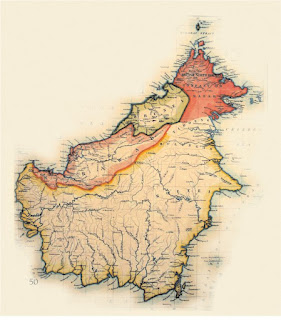
Moses was more interested in making money for himself. He saw that the Sultan hoped to use US presence in Brunei as a counter-weight against Sarawak expansion. (The Sultan had given Sarawak to James Brooke in 1846 for the latter’s role in curbing piracy… and now James Brooke wanted Sabah too!)
Borneo (Google Image)

With the dwindling empire/sultanate, the Sultan and his pengirans were getting less rich  due to loss of income because there were fewer subjects from whom to collect poll-taxes. Moses shrewdly persuaded the Sultan to lease him large concessions in Sabah for yearly rents.

Sultan Abdul Mumin leased the land from the Sulaman River to the Paitan River for $4500 annual rent. The Pengiran Temenggong signed another agreement to lease Benoni, Kimanis, Paitan, Sugut, Bongaya, Labuk, Sandakan, Kinabatangan, Cagayan and Muming for $4000 annual rent for ten years but could be renewed.

(Note: Brunei also leased areas which were not under its jurisdiction but were supposed to be under Sulu rule. Why? More about this later…)

Moses was now ‘lord and master’ of huge tracts of land in Sabah leased from the Sultan. Was he going to develop the land? No. This was before the rubber era of the next century. Was he going to collect taxes on the inhabitants of his concessions?  No! Moses quickly left for HK and was able to sell his concessions to two Americans—Joseph William Torrey and Thomas Bradley Harris, and a Chinese named Wo Hang.
Harris and Torrey (Google Image)

Torrey formed the America Trading Company of Borneo (ATC) to develop the land he had acquired.

Sultan Abdul Mumin signed a document on 24 November 1865 appointing Torrey as Rajah of Ambong and Maroodoo with the powers of life and death over the inhabitants; the right of making laws, coining money, creating an army—together with the powers and rights usually exercised by and belonging to sovereign rulers. So, Torrey was made a white rajah just like James Brooke in Sarawak!

With 12 Americans and 60 Chinese, the ATC opened a settlement in Kimanis. The new settlement was given a pretty name: Ellena. The plan was to develop commercial agriculture planting sugar cane, tobacco and rice. Unfortunately, the company had to be abandoned at the end of 1866 due to a number of reasons. Thomas Harris died after suffering a high fever. There was shortage of capital; there was sickness among the settlers and there was  labour unrest.
Thomas B. Harris's tombstone at Kimanis

Torrey returned to HK to look for someone who'd be interested to buy his property. Among those who expressed interest in this far-flung wilderness was Italy. Apparently, Sabah was perfect for a penal outpost where convicts could be sent to exile! Didn’t happen, by the way. (Can you imagine Romeos and Juliets labouring in the paddy fields and living in little water villages?)

1875: Finally, after almost ten years of looking for a buyer, an Austrian named Gustavus Baron Von Overbeck, offered Torrey $15,000 for the concessions if the Sultan of Brunei would renew the leases. The Sultan refused! So, Overbeck, having been turned down by Vienna, turned to Dent Brothers (London) for financial support.
Alfred Dent (Google Image)

1877: Alfred Dent saw great potential in the Sabah venture so in March 1877 they formed the Overbeck-Dent Association (ODA) to obtain the Sabah leases with the intention of selling them for a profit.

Dec 29, 1877: Sultan of Brunei leased his Sabah estates to Overbeck and Dent for an annual payment of $16,000—except for some tulin/private lands from Kimanis Bay in the west to the Kinabatangan River in the east. ODA appointed William Pryer as the first Resident of NB. He was to be based in Sandakan, was to eradicate piracy and establish an administrative centre for NB.
Photo credit: J. Kessey

A few weeks after the Sultan of Brunei had leased his lands to ODA, the Sultan of Sulu also sold his share of NB to Overbeck.

1883: Pangalat, Putatan, Kawang and Mantanani Islands were leased by Brunei to the British.

1884: The Sultan of Brunei signed over the Padas and Klias Rivers, and Tuaran, Bongawan for additional sums.

Jan 22, 1878: The Sultan of Sulu on the island of Maibu ( having been ousted from Jolo by the Spanish) relinquished his claim on all his territories in return for $5000 [five thousand dollars] a year, the same land the British was already paying $12,000 per year to Brunei.

1898: By 1898 the British NBCC owned the rights to every square centimeter of land in Sabah.

Now, Koyoh and Gurongit, which part of Sabah did some clown claim belong to them?

Love,
Aunty Tina


(p.s. Homework! Find out when the leases were transferred from ODA to the NBCC.)


Reference: British North Borneo Herald

Thursday, May 31, 2012

More about the wild men of North Borneo


“Do you live on trees?”

It’s one of those questions people from WM are fond of asking us. If it’s a ‘valid’ question and is due to ignorance about the people of Sabah, we’re quick to answer them, “No”. If it’s asked because the enquirer is being mischievous, we’re also quick to humour him: “Yes… we have an elevator to take us up and down. And we use the telephone to communicate.”

It’s funny when one considers that we’re a small country, albeit separated by the South China Sea, but many people in WM know very, very little about Sabah. “Welcome to Malaysia,” they would say when we visit WM and we tell them we’re from Sabah. It’s as though they don’t know that Sabah is in Malaysia. Or if they knew Sabah is part of Malaysia, they’d think we’re on the East COAST where Terengganu is… or maybe even IN Terengganu itself!

Sometimes one wonders if they’ve ever seen a map of Malaysia where Sabah, Sarawak and Malaya are shown in the correct proportion. Or perhaps they’re only familiar with the  map of the country they see on TV, the one which is distorted and shows  Sabah and Sarawak much smaller than the ballooned up Malayan Peninsula!

Why the common assumption that we Sabahans live not in houses anchored to the ground but on trees tops—like the orang utans?
Photo: Philippe & Sons, Sandakan

Someone could have seen a postcard of long ago depicting a tree house, and later  generations take for granted that life hasn’t changed in the last 150 years. Actually, the tree house must have been built by people who lived on the flood-prone river bank—an ingenious way, I think, to avoid dangerous, wild animals and to keep safe during floods. And since much of NB was dense virgin jungle, it made sense to build houses near rivers for easy access to food and water. Rivers were also important for moving around in boats or rafts.
Google image

However, it must be remembered that there are more than thirty suku kaum in Sabah. Some, like the Bajaus and Bruneis, traditionally liked to live on river banks. They made excellent boatmen and fishermen. The Dusun people, on the other hand, were mainly tillers of the soil and did not necessarily live along river banks. They preferred the hills and plains where arable land was plentiful and clean water available in springs and wells.

Perhaps one of the reasons the Sabah natives got along well with each other was their trait of minding their own business—making sure that their families had enough to eat, a roof over their heads, etc and they had no time to poke their noses into other people’s affairs or to jaga tepi kain orang lain. They met regularly, of course, on tamu days to barter trade—the upland people with paddy, tobacco and forest produce while the coastal and river people brought their harvests from the sea and river and products—fabric, jars, utensils—they had obtained from other traders.
Google image

I haven’t met anyone who lives among the branches of a tree but I don’t mind living in a tree house myself… a tree house that has a great view, modern plumbing and utilizes solar power. Heaven on earth!

Wishing you all a wonderful Kaamatan celebration. Cheers!

Thursday, May 17, 2012

The Wild Men of Borneo


Ugly? The Dusuns? Yes, according to the author of With the Wild Men of Borneo (Published 1922). I could have blown a fuse if I had not thought Ms Mershon’s opinion hilarious!

 Was she really talking about us, the Dusuns? Had she really seen at least a few Dusuns face to face before she pronounced our ancestors ugly? Or did she imagine that we looked like Waino and Plutanor aka the 'Wild Men of Borneo'? Incidentally, these 40-inch tall gentlemen were actually Hiram and Barney Davis, two mentally disabled brothers who captivated gawkers with their feats of strength in the 1850s. They were said to be from Borneo but they were actually from a farm in… Ohio!
Hiram and Barney Davis (Google Image)

Anyway, back to this book…
Click on picture for larger image.

When the author came to North Borneo with her missionary husband she said—at the beginning of her book—“All I knew about the country was that it was where the wild men lived, and I always imagined that they spent most of their time running around the island cutting off people’s heads.”

Despite the derogatory remarks and the harsh words she used to describe the natives, it’s an informative book and tells about her boat trip and what life was like in Sandakan in the earlier part of the 1900s. However, I must tell readers that what the writer said about the Dusuns being ugly is not quite correct. Perhaps the writer’s declaration was coloured by prejudice or ignorance? 

Those days we were not ‘civilize’ if being civilized meant living, dressing and eating like the people in western countries. Okay, we were illiterate but illiteracy doesn’t make one ugly, does it? Until the first schools were established around 1900, kids didn’t go to school in NB. Many foreigners must have assumed our ancestors were savages living in the land of the lawless. Wrong. They observed rules. There were taboos. There were laws to live by.
Dusun maidens at the tamu. (V.Wah)

If our ancestors went around with their bodies barely covered in sarongs and loin cloths, it was probably because that was how they dressed to beat the hot weather. And perhaps woven fabric was scarce too… and therefore, expensive or reserved for special occasions.  Now it’s common to see people—whose civilizations are older and much, much more sophisticated than ours—braving their cold weathers dressed in barely-there garments. We may wonder at their ‘hardiness’ but we don’t criticize them. Of course, some people—like my mother who doesn’t know any better—would say, “What a shame! They must be too poor to buy decent clothes.”
Dusun girls (Photo: D.Lau)

As a community our ancestors were known to be gentle, hardworking and honest. They  looked out for one another and were civil to all… except when face to face with members of enemy tribes. In such situations our ancestors took great delight in chopping the heads off their owners’ shoulders. It was a form of sports, this removing of heads, an opportunity to collect trophies and later (having preserved said trophies by smoking!) show them off—as Stephen Holley found out when he was a District Officer in NB!

However, our ancestors didn’t “spend most of their time running around the island cutting off people’s heads.” They had to grow their own food, go hunting and fishing, clear land for agriculture, have parties and celebrations, take care of their kids, they communicated with the spirits…you know, the usual stuff people in other cultures did or are doing…except the Dusuns didn’t go chasing other people’s spouses. That was strictly forbidden and fines were imposed on those who lusted and ran after other people’s wives or husbands.

What did the British think about the Dusuns back in the 1880s? Let me conclude with an excerpt from the North Borneo Herald (1 September 1888), the fortnightly newspaper:
Dusun girls circa 1915 (Oscar Cook)

“Within the limit of each tribe crime is unknown. All are equal—none are wealthy, none are absolutely in want, each one with aid of hardworking wife and kids, provides with his own hands the family’s requirements. Land yields rice, tapioca and surplus goes to the pigs beneath the house. Close to the house—garden with tobacco, betel-nut for enjoyment of all including the children; kapok tree furnishes cotton which women deftly weave into durable sarong and waist clothes. For every man there is a wife, for every woman a husband. Among such a people the passions of envy, covetousness and lust, which are the source of crimes, which law has to check and punish, do not exist. There is, however, a passion which appears to be implanted in the whole human race, from what we deem the highest and most civilized to the lowest and most barbarous. This is the savage delight of shedding man’s blood. This passion exists equally in the Dusun…”  

Friday, May 11, 2012

Merdeka!


Sabah is a land of potholes where, when the moon turns blue, politicians come to visit and to make long speeches and scatter empty promises. They tell us we should be grateful. They tell us not to complain. “Sabah richest state soon: Dr M” the headline screamed on 2 May. What are we? Dumb and Dumber?

People who are strangers to Sabah don’t understand why we’re forever ranting about the injustice and unfair treatment we get from the federal government. Anak tiri, we call ourselves because that’s exactly how we feel.

Maybe we would not feel so bitter and angry if we hadn’t known a better time.

Sabah used to be a British colony called North Borneo but in 1963, chose to join Malaya, Singapore and Sarawak to form a brand new nation called the Federation of Malaysia. No, that’s not right. Let me re-phrase that… One third of Sabahans were in favour of forming Malaysia, one third against it and the rest were not sure. But Malaysia was formed anyway and Sabah found herself part of this new nation after declaring independence (from British rule) on 31 August 1963. Two weeks later, on 16 September, the Federation of Malaysia was formed. Apparently Singapore’s PM grew too big for his shoes so the pulau was booted out after only two years in the federation. It must have been easy kicking it out because the pulau lies at the tip of the peninsula… somewhat reminding me of a rhyme learnt in primary school: ‘long-legged Italy kicked little Sicily out into the Mediterranean Sea’.  

Across the South China Sea, Sabah—having been run and administered by the British for eighty years, was inexperienced and immature in politics and naively assumed that the central government really had the people’s interests at heart. However, 48 years in the federation, not only is Sabah still playing catch-up with the peninsula but we have been reduced from the richest to the poorest state. These days Sabah is often reminded to be grateful for pitiful handouts and because we are “merdeka melalui Malaysia”. Don’t even ask me what this means because I am confused too.

When that former PM was in KK at the beginning of May, he mentioned about his first visit to Sabah in 1965.

 “There were rumours,” he said, “that Sarawak and Sabah were going to join Singapore to form a new country.” So he and a fellow politician flew here to appeal to Sabahans not to leave the federation. During this visit he noted that there was this “Sabah leader who had a Jaguar car but he could only drive it past his house and a few kilometers ahead before having to return home”… because the road was very short!

I guess all the travelling this former PM did in Sabah was from the airport in Tanjung Aru to a hotel in town. Otherwise, he would have spotted the road running from  Jesselton/KK to Kota Belud. For half the distance it was  narrow and winding, no doubt, but nevertheless, it was 50 miles of sealed road—all built when Sabah was still a British colony.

Now we’re merdeka melalui Malaysia but our roads are nothing to crow about. In fact, many WMalaysians come here and make fun of our roads. “Our kampong roads are better than your highways,” they say. (Actually, Samivelu, when he was the JKR Big Boss, had said, “There are no highways in Sabah, only trunk roads.” I’m not here to tell people to mind their vocabulary. Not today, anyway.)

No doubt these comments are meant to embarrass and humiliate us…as though we are personally responsible for the poor condition of our roads. Surely they know that roads and bridges are under the purview of the federal government?

They boast about their twintowers and other sky-scrapers, their LRT and MRT, their keretapi and sky-bridges and their multi-laned highways lined with street lights. They come here and laugh at our old buildings and the mini craters scattered on our trunk roads and (if they happen to drive at night after a weekend on the mountains) they complain there’re no street lights just a few miles out of KK. They have no idea about the deplorable state of our roads just a few miles out of the city. Street lights? As rare as a federal minister’s visits.

Interestingly, when the current road and transport minister was here a few months ago, he said that Sabah roads are as good as those in WMalaysia. However, judging from pictures and petitions published in the dailies, websites and on Facebook, many Sabahans don’t quite agree with the YB’s statement.

I found the following pictures online. They’re credited to 1 Suara Sabah unless the original sources were traced. Let the pictures speak for us, the anak tiris.
Courtesy of 1Suara Sabah


Courtesy of 1Suara Sabah

Courtesy of 1Suara Sabah

Courtesy of 1Suara Sabah

Courtesy of D. Aloysius


Courtesy of J.A.Dusun

Courtesy of 1Suara Sabah


Courtesy of 1Suara Sabah


Courtesy of W.M. Majupi


Kids on their way to school. (1Suara Sabah)

On the way to school (Cikgu Mereni)

This is in Malaya. Courtesy of Derek Dryland

Same sky bridge in Malaya (D.Dryland)


Are you convinced that the roads in Sabah are as good as those in Malaya?

We frequently ask: what happens to our oil revenue?


The former PM said S. Arabia produces 12 million barrels of oil per day. We’re not interested in how much oil (or dates or sheep or manure) other countries are producing. We just want to know where the 95% of our oil revenue is piped to because we need money to build better roads and repair the old ones. We’re not begging for other people’s money. We’re only asking for what rightfully should belong to Sabah.