Showing posts with label leisure. Show all posts

Sunday, June 30, 2013

Praying for a Pumpkin Gourd

“They’re taking too much space in the backyard,” Mr. Hubby said. He was complaining about my unproductive pumpkin vines. “You should just mow all the plants and make the place neat and tidy.” 

I couldn’t do that, not when I had set my heart on producing a 15-kilo pumpkin! My initial two plants had produced five beautiful gourds the biggest being eleven kilos. I thought with my second crop of more than twenty vines I could have a truck-load of pumpkins. Maybe I could even sell pumpkins at the tamu!

However, not a single pumpkin appeared on the vines. Even Mr. Neighbour noticed the barrenness.

“No pumpkin gourd this time?” he asked Mr. Hubby. “Perhaps your pumpkin plants are males.” He thinks pumpkin vines are like papaya trees.

Mr. Hubby didn’t tell him that the cause of the ‘missing’ gourds was the once-a-week maid. I made the mistake of telling her she could pick some pumpkin shoots for her pot. Little did I know that the picking would be a regular thing. When she was plucking the shoots for the second time, I told her not to take the flowers. Well, she left behind the female flowers but what use are these without the pollen from the male flowers?

When the female flower blooms it needs to get pollen from a male flower

A female flower needs to be pollinated so it has the chance to become a pumpkin gourd.

The next time she took the young shoots for her pot she told me only when the plucking was done. The following week I told her bluntly: “Don’t pick any more shoots until we have pumpkin gourds.”

Many people think that when a flower with that tiny pumpkin appears, it automatically becomes a gourd. It does not become one unless it gets pollen from a male flower. Insects such as ants, bees and beetles normally help to pollinate the flowers but the gardener can also do it manually.


The maid took all the young shoots

We didn’t explain that to Mr. Neighbour and I didn’t point it out to the maid. I had assumed she knows more about growing pumpkins than I do. Too bad, she doesn’t. 

However, I was still hopeful. The occasional flowers are still appearing on the vines. I only wish that healthy male flowers make an appearance when the female flowers are dancing in the morning sun. You can imagine how pleased I was to pollinate a flower about a month ago and how I watched the baby pumpkin grow. After a six-month wait we were going to have a gourd at last, I told the family and the maid.

But I had spoken too soon. The back neighbour hired a walk-in grass-cutter to trim her plants yesterday and he had snipped all the plants crawling on MY fence. (The neighbour had removed her fence long ago so she could claim the no-man’s land between our properties.)The cut pumpkin vines are drying up and turning brown. I am more disappointed than angry. It is as if I haven’t planted any pumpkins and I had wasted six months.
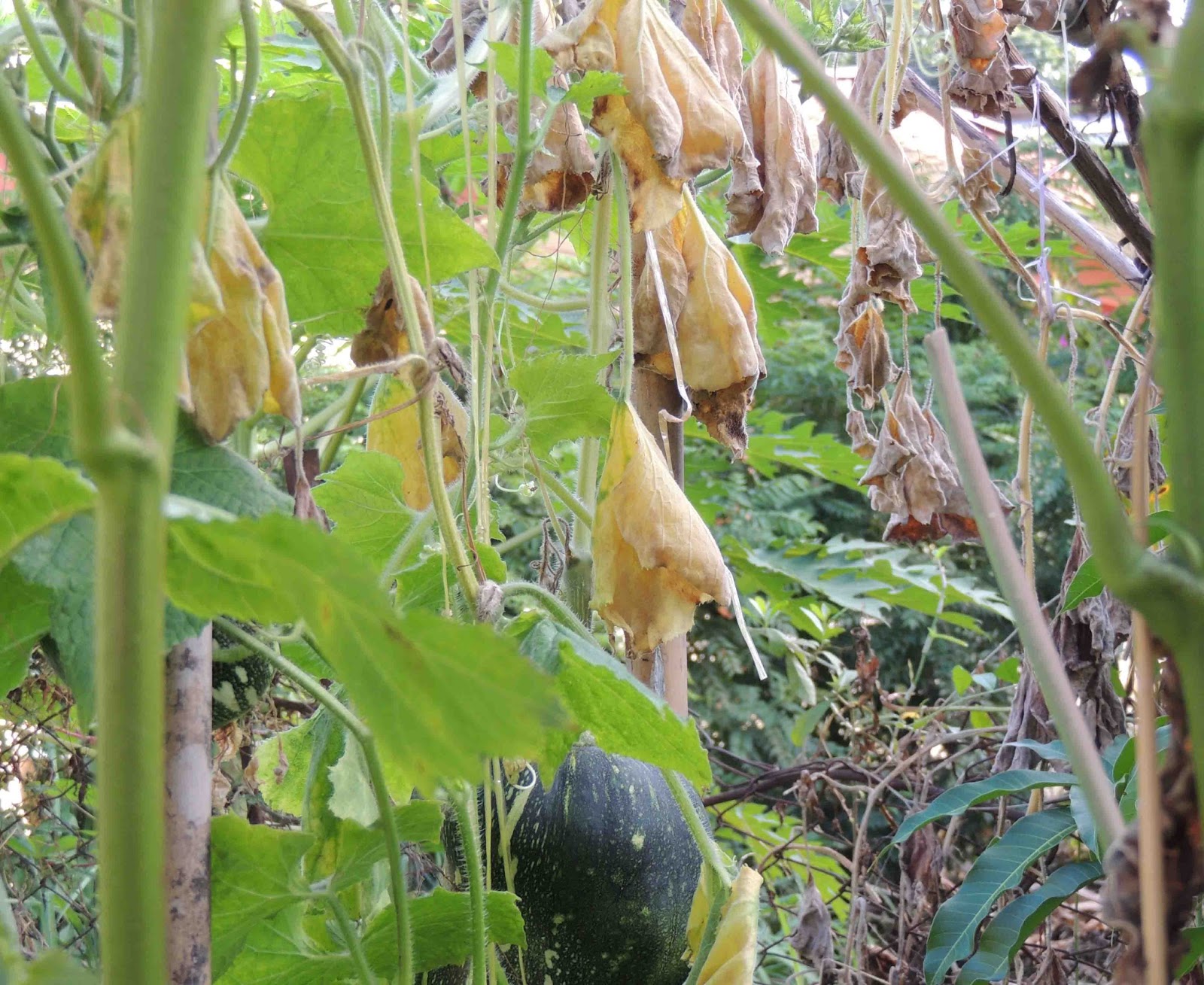
The pumpkin is still small and the plant is drying up.

There's only one thing to do now and that is to go sow more seeds. In three months I'm going to have a tubful of pumpkins! 

Wednesday, January 09, 2013

My Affair with Pumpkins


All I wanted to do was to crawl into a corner and sleep. I had just completed  my last ‘assignment’. It involved researching and co-writing a coffee-table book. It was a huge project to undertake with a small team (which eventually shrank to four people) as it also included reading, editing, proofreading, etc of articles and stories for the book. That project and personal commitments left me mentally exhausted. So I ignored the invitation to join AEG, a Fb gardening group created by Ms Vera, until a second invitation came along. Only then did I go and have a look-see at the members’ discussions and view photos of their gardens and plants.

What I saw and read led me to believe that I could revive my kebun too. I could grow organic vegetables just like the members of AEG! I now had a reason to reclaim the backyard from the lalang and rumput sundal.

Within a day or two I had cleared the tiny—but overgrown and long-neglected—vegetable bed. (That was an achievement for a couch potato whose most strenuous daily activity had been climbing up the stairs once—at bedtime. Gravity helped with the walking down in the morning.) It was there in the compost heap—where I had discarded chunks of moldy pumpkin—I stumbled upon two healthy baby pumpkin plants smiling in the sun.
Baby pumpkin plants

Ten days later...


My experience with pumpkins had been limited to buying sliced sections at the tamu. The only time I had planted a pumpkin was years ago. My vine had produced many orange-coloured blooms which fell off and left a stump filled with tiny, white, wriggling maggots. The lone pumpkin gourd produced by this plant was discovered by my mama—who happened to be visiting—sitting atop the orchid shed. It had made my day, getting that single gourd, because I had already given up on that plant.

So when I saw these two tiny pumpkin plants among the old charcoal pieces and broken egg shells, I let the babies grow. I threw around them a handful of chicken manure, the only fertilizer I had. Later, I discovered that horse manure could make pumpkin plants grow almost as fast as Jack’s beanstalk.
My 'tie and die' method


Using odds and ends, I built a simple four-posted frame topped with a sheet of wire-netting which would support the pumpkin plants after they’ve crawled up a post. It was really a ‘tie and die’ thing… I used strings to tie sticks to wooden posts stuck in the ground and if the frame fell, die lah. I thought I could save the space below this structure for other plants. Big mistake bah! Plants need sunlight and too much shade inhibits growth. My chili plant grew tall and spindly and didn’t flower at all. The tomato plants did very well initially and then just wasted away as the pumpkin vines thrived on the wire netting above them. Before I could stop marveling at the egg plants, they too began to show signs of ‘ill health’. They needed the full sun too.
Pumpkin vines on the wire netting


Okay, back to those pumpkin plants. They started producing big, orange flowers before they were two months. At first all the flowers dropped without a single one turning into a gourd. It reminded me of my first experience and I wondered if these flowers were also infested with those tiny, white worms. I didn’t know that they were male flowers and that the female flowers would appear only much later. Then one fine morning I found a flower with a cute, little pumpkin at its base. A female flower at last! Had I known better, I would have fertilized all the female flowers manually. Unfortunately, I left everything to the bees and the ants. Many flowers withered without being fertilized.
Male flower

Female flower

Fertilizing a female flower manually

Fertilized flower


At three months old the plants produce mainly female flowers. Without the male flowers, they are not good. Somebody likened the flowers to boys and girls arriving at a party. The boys arrive first, in big numbers. The girls shyly trickle in later. Then, much later, more girls, encouraged by each other perhaps, arrive in a crowd. But the boys, having waited so long, have all left! The last girls don’t even get to meet any boys.
My beautiful pumpkin gourd!


Now, how would one—with limited space for pumpkin growing—solve this problem? I think by sowing a second seed (Plant B) two or three weeks after the first seed (Plant A) the novice gardener could use the early male flowers of Plant B to fertilize the late-comer female flowers of Plant A.

Had I been smarter I could have had several pumpkins. However, I am still very happy to have harvested five beautiful pumpkins. The biggest weighed a hefty eleven kilos!

The vegetable patch has already been prepared for another round of crop. I hope to be able to produce a 15kg pumpkin gourd. My seedlings are just a week old but I’m already wondering what to do if there’s a bountiful harvest! I guess I can make pumpkin pies, pumpkin pancakes, pumpkin/santan dessert and pumpkin anything for breakfast, lunch and dinner.  

Thanks to AEG, this great group of happy and generous gardening enthusiasts, I was inspired to wake up from hibernation, get off my bum and rekindle my interest not only in gardening but also in photography. Who would have guessed that an online gardening group could inspire this ‘old and mighty writer’ (someone’s description of me… sniff-sniff… long story) to change couch for cangkul and turn over a new leaf?
A brown-throated sunbird in the backyard


May your plants and gardens bring you joy and serenity… and may they get visited by beautiful birds. Cheers!


Sunday, July 22, 2012

A Secret Nature Hideaway?


Are you familiar with the old network of salt trails crisscrossing the Crocker Range? Some of these trails are more than a hundred years old and were the only means of communication between Tambunan, in the interior, and the coastal towns of North Borneo. For countless generations, Dusun barter traders of Tambunan carried produce to the tamu at Inobong where the trails end, and returned home with salt, dried fish and other items from the coast…hence, the term ‘Salt Trails’
The Inobong-Tikolod trail; follow the stars

One such trail runs from Inobong (in Penampang) and ends at Tikolod in Tambunan. This particular trail is now being promoted by the Sabah Parks which—in 2002—established the Inobong Sub-Station.

I was among a big group of senior citizens given the chance to visit the place last week. A steep road led us to the Inobong Station. It’s on the Crocker Range but the road isn’t as steep as the one leading to the Kokol Hills where we went twice.
A small tree marks the starting point of the trail

The start of the Inobong-Tikolod Salt Trail is marked with a tree. It is 35.8km up and down the Crocker Range to Tikolod. (By road, the distance to Tambunan is twice that of the trail.) For a fee, trekkers are guided by Park Rangers all the way to Tikolod and back with night stopovers at three villages. It takes four days and three nights to make the round trip.
Two blocks of hostels and a single chalet

Two blocks of hostels and one chalet are available for paying guests. There’s even a barbeque pit at the side of a gazebo. From here one can admire a panoramic view of KK and the South China Sea—the same view that must have signaled to those long-ago barter traders that they had almost reached the end of their trek and could soon rest their tired legs as well as unload the weights off their backs.
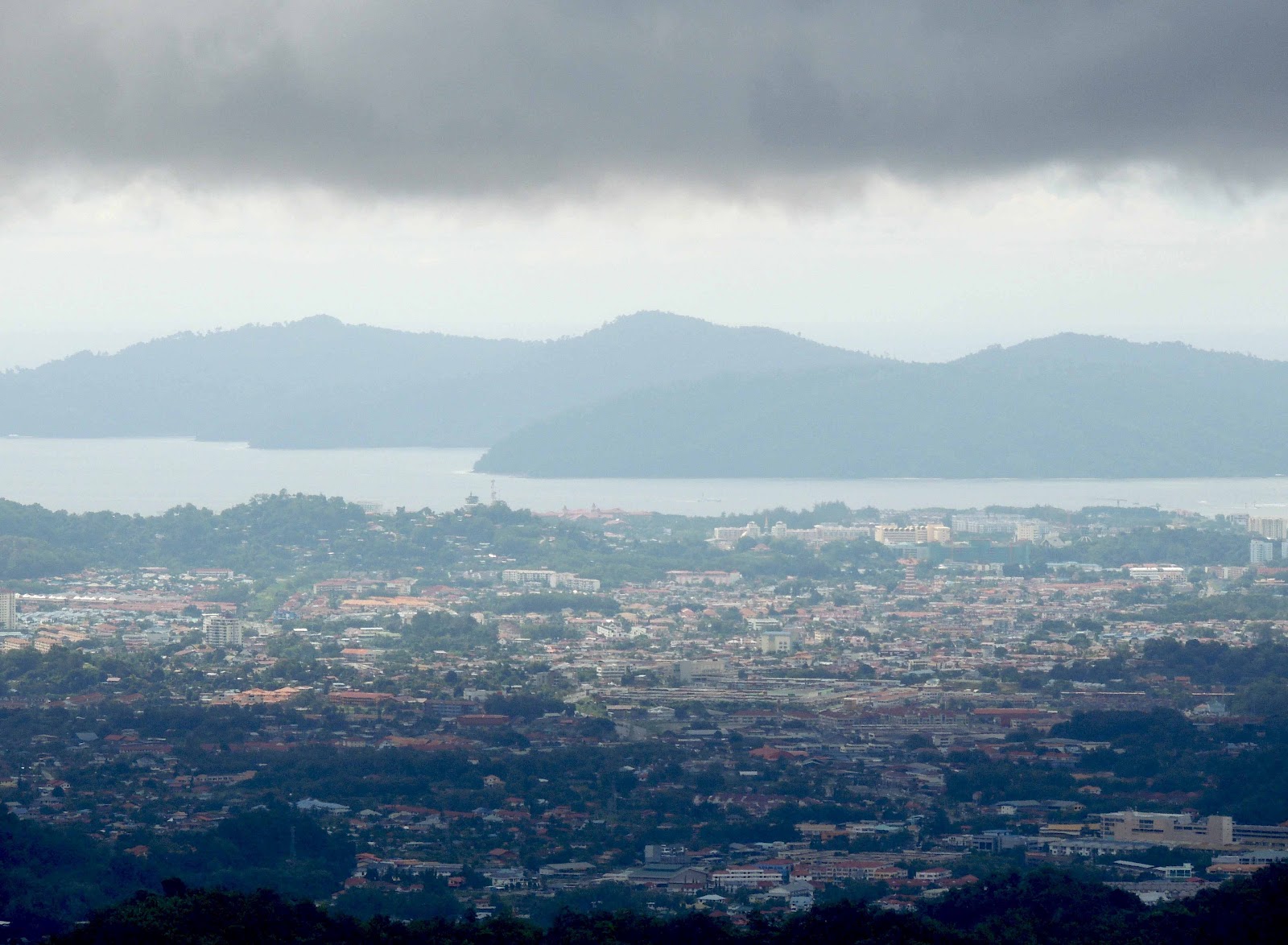
Rain clouds over KK

Now the bad news…

The Inobong-Tikolod trail happens to be in the valley where the government plans to build the Kaiduan mega-dam. If the dam is built, all this area—along with the villages in it, all traces of civilization such as stone markers, oath stones, graves, historical and cultural sites going back several generations—would be wiped out. And what a tragedy that would be!

The people in the many villages here are subsistence farmers planting mainly rice and tapioca as staples. They are happy to be where they have been for several generations. The older residents could still recall what life was like before the war and during WW2 when many Chinese from the coastal towns made their way to the river valley to escape the atrocities of the Japanese occupation.

If the dam project is scratched, not only villages and buried ancestors be prevented from drowning but countless species of plants and animals would be preserved too.

Okay, back to the Inobong Sub-Station…

I mentioned about the visit on Facebook. Apparently, not many people know about this nature haven although it’s just several minutes outside KK! Could this have been a well-guarded secret? If it was, the cat is out of the bag now! I’m definitely going there soon. Who wants to come along? Susan? Rosemary? Frank? A friendly tiger would be good company. Don’t forget to bring your camera!

Friday, June 08, 2012

Off to the Races!


What is all this excitement at the racecourse that can make grown men act like kids with a brand new toy? Well, just the other day I went to see for myself. It was the first time I went to the race tracks since the Royal Sabah Turf Club (RSTC) moved to Tambalang in Tuaran—although I’ve been to the stables many times. I didn’t know what to expect, except ponies and horses and their jockeys, of course.

But first a little history about pony racing in Sabah…  

Initiated by the European community, the first pony races in Sabah were held in Sandakan in 1892. The pony race craze and excitement spread to the other towns and tracks were made in Jesselton, Kudat, Kota Belud and Labuan. Incidentally, when the North Borneo Chartered Company (NBCC) was looking for an alternative site to rebuild the town after the 1897 fire at Pulau Gaya, the Company noted that the wide open ground at Tanjung Aru would be perfect for a racecourse.

The first tracks were straight and only four furlongs (half a mile) in length. These tracks were later formed into rings which exceeded eight furlongs. The earliest ‘grandstands’ were viewing shacks of wood and attap. Even posts were good as viewing stands! Now there’s a modern grandstand at the Tambalang race course in Tuaran and it can accommodate thousands of spectators.


Whereas today the riders/jockeys are local men, during the NBCC era, only Europeans were permitted to ride in Jesselton and Sandakan. In the smaller towns, because there were not many European riders, the natives were allowed to compete with the white men. 

The ponies were of Mongolian breed and were brought in from Southern Philippines. Apparently, the Bajau people of Kota Belud have been rearing ponies for generations, hence earning the name ‘Cowboys of the East’. During the NBCC days the ponies were actually used as draught animals for higher ranking officers who qualified for ‘pony allowances’.

These days besides ponies, there are also horses and cross-breeds reared as ‘racehorses’. I’ve been told that race ponies can’t be ‘retired’ as ‘walking’ ponies because they’ve been trained to only run and not to slow canter. Well, at least that was what Mr. Hubby-knows-it-all told me when I suggested we adopt some of the old, unwanted ponies and rent them to leisure riders.

What I saw and learned at the races…

I thought only men go to the races but many women and children go too.

The ponies and horses are walked twice around this oval pitch in front of the grandstand… like beauty contestants, I thought.


The tracks are smoothened… and then sprayed with water before each race.

There were special ‘Cup’ races the day I went because Sabah was celebrating Tadau Kaamatan. Winning ponies receive their prizes immediately after each race.

Many people place bets on their favourite ponies. Forecasts appear in the local papers to ‘help’ them predict and pick the winners.

A jockey has to watch his diet and I’m told he normally weighs around 55kg only! The RSTC pays the jockey a riding fee for each of the race he runs. The RSTC also keeps track of the jockeys’ performances and awards are given to the ‘Champion Jockey’ every year.

Mr. Hubby’s pony didn’t win that day. Sakit kaki konon.

(Angel Bear, if you're reading this... we'll go to the stables one of these days when you're not busy.)

Sunday, July 10, 2011

ORCHIDS, ANYONE?

If you’re new to orchids and you’re thinking of starting a collection, check out Orchid Magic. It’s a fun read and the writer asks you to take an oath: I will not kill my orchids.

Phalaenopsis equestris (Click on pic to enlarge)

A plantlet growing at the tip of the spike


A friend gave me my very first orchid. It was a baby phalaenopsis equestris. I knew I was not doing anything right because for years and years the orchid had only three leaves. Every time a new leaf appeared the oldest leaf would dry up and drop. Then one day the plant decided to bloom and reward me for my patience. Lucky I didn’t cut off the spike after the blooms dried up because a new plant grew on the spike. From one orchid I soon had several new plants and still had many to give away.
 
A new spike on the cymbidium aloifolium  
The spike grows to about one metre

Close-up of the cymbidium aloifolium


The cymbidium aloifolium I got from a colleague who lived a few houses away. I was admiring the plants outside her rented house while waiting for her to get ready for school—we car-pooled—when I noticed this blooming orchid in the dirt under a mango tree. 'Poor orchid,' I remember thinking, 'you should be up in the tree, not crawling on the ground.' Zuraidah let me tease out a plantlet (or keiki—Hawaiian word for baby) from the mother plant and I stuck it in the branches of one of my bushes. One day it bloomed and it has been blooming once or twice a year ever since.

My cattleya bloomed recently


I love cattleyas too but I find them very fussy. A few years ago I saw a spike forming in one of my orchid pots and was so excited and looking forward to the bloom. For no apparent reason, the spike refused to let the buds cut through the sheath enclosing them. Then it withered, shrunk and turned brown. There was no flower show. Of the cattleyas, I have only three colours: pure white, white with yellow lip and purple. The pure white cattleya bloomed three weeks ago and the flowers still look fresh. The purple blooms don’t last as long.
 
Drendrobium anosmum


I bought one dendrobium anosmum  at Gaya Street several years ago. This plant multiplies quickly, grows very easily and produces a spray of scented, light purple flowers. I dream of my dendrobiums developing multiple spikes so the flowers will look like a thick curtain of lilac stars but I guess that’s asking too much. 

I was so excited when a freak appeared recently!

I dream of having a shower like this! (Google pic)


Orchids don’t need much room and are easy to take care mainly because they are off the ground and weeding (or digging!) isn’t necessary. But you’ve to keep the slugs and snails away otherwise they'll climb up and make your orchids their permanent home. They’ll have no reason to leave when succulent leaves and pretty flowers make ready food.
 
 I sprinkle ‘siputox’, which comes in tiny pellets, under my orchid shed. The snails party on these and ignore my plants. The ‘organic’ method is to put a little left-over food in a bowl/container, add some water (so the solid food is swimming) and leave in your yard. The slugs and snails will have a swimming party and drown! Oh, they love beer too!  

Maybe you have orchids and would like to share something about them?